[Maeumjigi Capstone Dev Log #14] All Fine-Tuning Completed and Parallel Inference (Eval) Pipeline Built

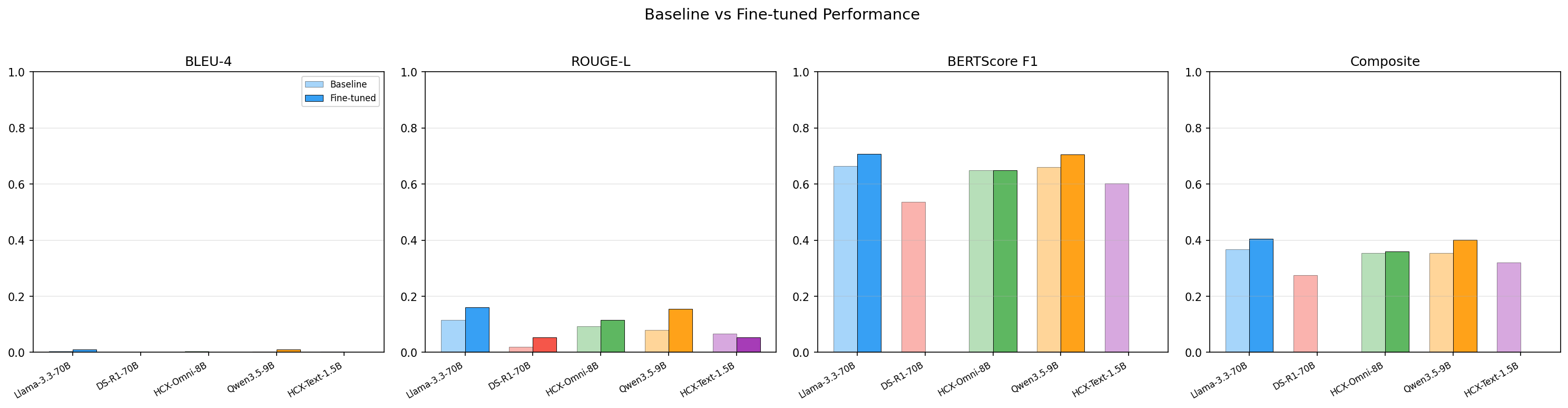
On May 6th, we finally escaped the long swamp of fine-tuning! After several nights of work and hyperparameter tuning, the training for mid-size models like HCX-Omni-8B and Qwen35-9B was successfully completed.
Fine-Tuning Complete, Analyzing the Logs
As the training progressed, we could see the loss values decreasing stably.
step= 1200  loss=0.9698  lr=1.88e-04  gpu=7.7GB
step= 1250  loss=0.8523  lr=1.86e-04  gpu=7.7GB
...
step= 1650  loss=0.8783  lr=1.73e-04  gpu=7.7GB
However, we had a brief moment of confusion trying to figure out if this was train loss or validation loss, asking the Artificial Intelligence (AI), "Does our code not record eval loss?" We realized the evaluation loss logging might have been missed, but since the training was already fully complete ("All fine-tuning is complete, proceeding with evaluation"), we immediately moved on to the inference and evaluation (Eval) phase using the latest generated checkpoint models.
Building a Parallel Inference Environment
We started generation testing using the 20_eval_ft_models.ipynb notebook to see how each model responded to user dialogues. We unified the max_new_tokens for inference to a generous 1024, constantly worrying if another OOM would occur.
But the inference speed was much slower than expected.
"We used two graphics cards for training, so why is inference only using one?"
To utilize 100% of the server's GPU resources, with the AI's help, we wrote a new run_eval_parallel.sh script to process inferences in parallel. This drastically reduced the model inference time, and we successfully built a pipeline that automatically aggregates the inference results and perplexity of each model into an Excel file.
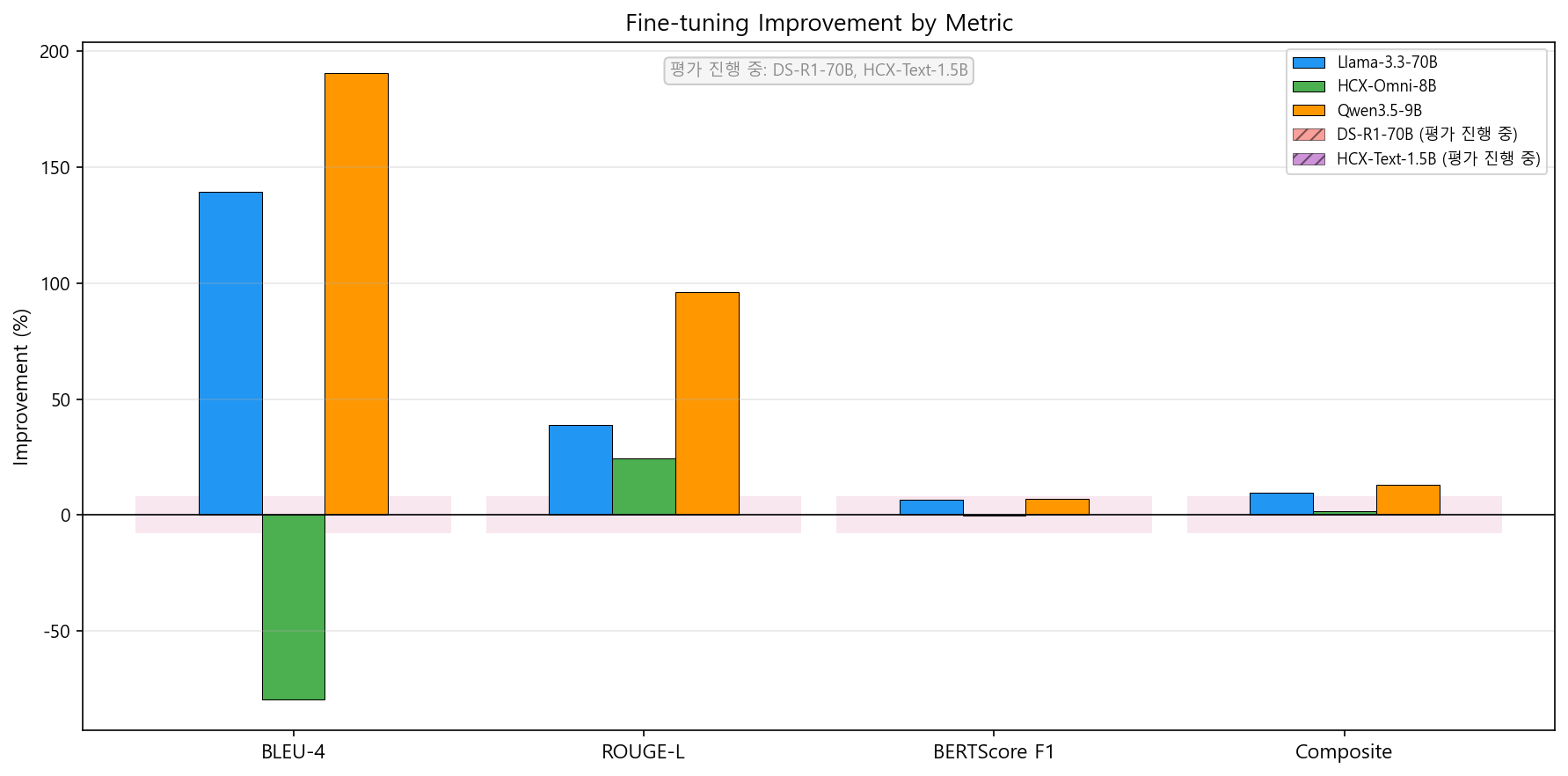
Although an error occurred because VRAM was not properly released when transitioning from DSR1-70B inference to the next model, we resolved it by isolating the environments with the parallel script. Now, it's finally time to compare the actual answer quality of each model!