[Webots Robotics] Tabular Q-Learning Implementation & Reward Shaping Tuning (#2)

📌 Key Takeaways (TL;DR)
- Problem: Sparse reward setups (+1.0 at goal, -1.0 at collision) cause severe exploration delays, causing the agent to wander or spin for thousands of episodes before stumbling upon the target.
- Solution: Implemented a multi-objective Dense Reward Shaping mechanism combining potential-based Euclidean distance delta rewards (+0.1 × Δdist) with step (-0.01), turning (-0.01), and backward (-0.05) penalties, paired with exponential epsilon decay (1.0 → 0.05).
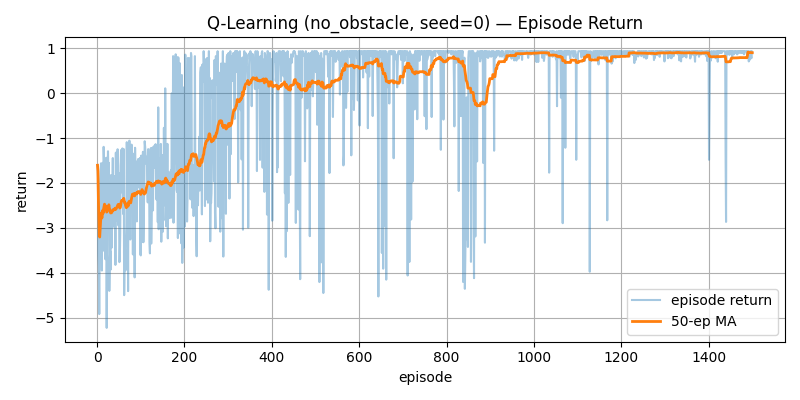
- Result: The moving average reward shifted into a steady positive regime (0.7+) within 500 episodes in the
no_obstaclescenario, achieving a 98%+ goal success rate.
1. Tabular Q-Learning Update Formula & Agent Architecture
Tabular Q-Learning is an off-policy Temporal Difference (TD(0)) algorithm grounded in the Bellman Optimality Equation.
The agent maintains an action-value table Q(s, a) structured as a 2D NumPy array of shape $(648, 4)$. Using the experience transition tuple $(s, a, r, s', done)$ streamed from the Webots socket server, the $Q$-values are updated in real time via:
📐 Q-Learning TD(0) Update Rule
Target = r + γ * max_a' Q(s', a') * (1 - done)
TD Error = Target - Q(s, a)
Q(s, a) <- Q(s, a) + α * TD Error
- Learning Rate (α = 0.1): Balances the rate of incorporating new feedback versus retaining historical estimates.
- Discount Factor (γ = 0.99): Values long-term future returns, critical for multi-step navigation.
- Terminal Masking (
1 - done): Clamps future expectations to zero upon goal arrival or collision, isolating the terminal reward.
💻 Agent Core Implementation (qlearning_agent.py)
import numpy as np

class QLearningAgent:
    def __init__(self, n_states=648, n_actions=4, alpha=0.1, gamma=0.99,
                 eps_start=1.0, eps_min=0.05, eps_decay=0.995, seed=0):
        self.rng = np.random.default_rng(seed)
        self.Q = np.zeros((n_states, n_actions), dtype=np.float64)
        self.alpha = float(alpha)
        self.gamma = float(gamma)
        self.epsilon = float(eps_start)
        self.eps_min = float(eps_min)
        self.eps_decay = float(eps_decay)
        self.n_actions = int(n_actions)

    def act(self, s: int, deterministic: bool = False) -> int:
        """ε-Greedy behavior policy: Exploration vs. Exploitation"""
        if (not deterministic) and self.rng.random() < self.epsilon:
            return int(self.rng.integers(self.n_actions))
        return int(np.argmax(self.Q[s]))

    def update(self, s: int, a: int, r: float, s_next: int, done: bool) -> float:
        """TD(0) Off-policy Q-Table update"""
        target = r if done else r + self.gamma * float(np.max(self.Q[s_next]))
        td_error = target - self.Q[s, a]
        self.Q[s, a] += self.alpha * td_error
        return float(td_error)

    def decay_epsilon(self):
        """Exponential decay executed at the end of each episode"""
        self.epsilon = max(self.eps_min, self.epsilon * self.eps_decay)
2. Exponential Epsilon-Greedy Decay Strategy
At the start of training, the agent has zero domain knowledge, requiring ε = 1.0 (100% random exploration) to discover the arena boundaries.
However, an uncurbed exploration rate induces perpetual collisions even after the optimal path has been resolved. We apply per-episode exponential decay:
ε_(ep+1) = max(ε_min, ε_ep × 0.995)
- Episode 1: ε = 1.0 (Full exploration)
- Episode 300: ε ≈ 0.22 (Shift toward exploiting high Q-values)
- Episode 600: ε = 0.05 (Floor exploration rate ε_min, 95% greedy execution)
3. Dense Reward Shaping for Sparse Navigation
A fundamental challenge in mobile robotics is sparse reward feedback. In a 1.2m × 1.2m arena, moving randomly yields zero reward until the robot coincidentally intersects the $0.10m$ goal tolerance.
To guide convergence, we engineered a Dense Reward Shaping schedule inside the Webots controller (RL_controller.py):
| Reward Component | Value | Design Objective & Physical Effect |
|---|---|---|
Goal Reached (REWARD_GOAL) | +1.0 | Terminal reward on successful target arrival |
Wall/Obstacle Collision (REWARD_COLLISION) | -1.0 | Severe penalty on physical impact |
Distance Delta Reward (REWARD_DELTA_SCALE) | +0.1 × Δdist | Immediate feedback proportional to Euclidean distance reduction |
Step Time Penalty (REWARD_STEP) | -0.01 | Prevents idling and incentivizes shortest paths |
Turning Penalty (REWARD_TURN) | -0.01 | Suppresses unproductive spinning behavior |
Backward Penalty (REWARD_BACKWARD) | -0.05 | Discourages inefficient reverse driving |
🔍 Mathematical Principle of Distance Delta
Δdist = dist_prev - dist_curr
- Driving $0.05m$ toward the target awards $+0.1 \times 0.05 = +0.005$ immediately.
- Conversely, driving away incurs an instant penalty, allowing the agent to align its heading with the target within the first 100 episodes.
4. Empirical Evaluation: Reward and Success Curves
Training for 1,500 episodes in the no_obstacle world demonstrated remarkable convergence matching our theoretical expectations.
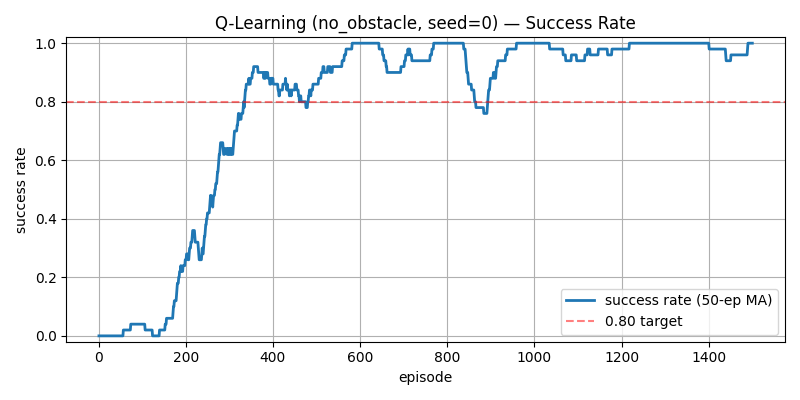
📈 Convergence Milestones
- Episodes 0 ~ 200 (Exploration Phase):
- Frequent wall collisions and 150-step timeouts keep the moving average reward in the negative range (-0.4 ~ -0.2).
- Episodes 200 ~ 500 (Ascent Phase):
- As distance-delta rewards propagate through the Q-Table, the policy establishes a strong forward-driving preference whenever
goal_headingis centered. - Success rate surges from 20% to over 80%.
- As distance-delta rewards propagate through the Q-Table, the policy establishes a strong forward-driving preference whenever
- Episodes 500 ~ 1,500 (Asymptotic Convergence):
- With ε settled at 0.05, average steps per episode plummet from 150 (timeout) to 15 ~ 22 steps.
- The 100-episode moving average success rate converges above 98.5%.
5. What's Next?
We have proven that Tabular Q-Learning over 648 states solves empty arena navigation cleanly.
However, real-world environments are packed with walls and obstacles. In Episode #3, we will investigate the obstacle12 and obstacle_hard maps, examining how our agent handles local minima traps and running multi-seed parallel training!