[Webots Robotics] Conquering Local Minima in 12-Wall Obstacles: Multi-Seed Headless Simulation (#3)

📌 Key Takeaways (TL;DR)
- Problem: When a goal lies directly behind an obstacle, the myopic nature of distance-delta rewards (+0.1 × Δdist) pulls the robot into head-on collisions, trapping it in severe Local Minima.
- Solution: Integrated 3-way head-scan obstacle perception (front/left/right) with long-horizon Bellman value propagation (γ=0.99), alongside an automated PowerShell Webots Headless pipeline (
headless_run.ps1) executing multi-seed training across seeds 0, 1, and 2.- Result: The agent successfully learned robust detour policies in the 12-wall arena, achieving a 90%+ goal success rate after 600 episodes.
1. The Obstacle Challenge: The Local Minima Trap
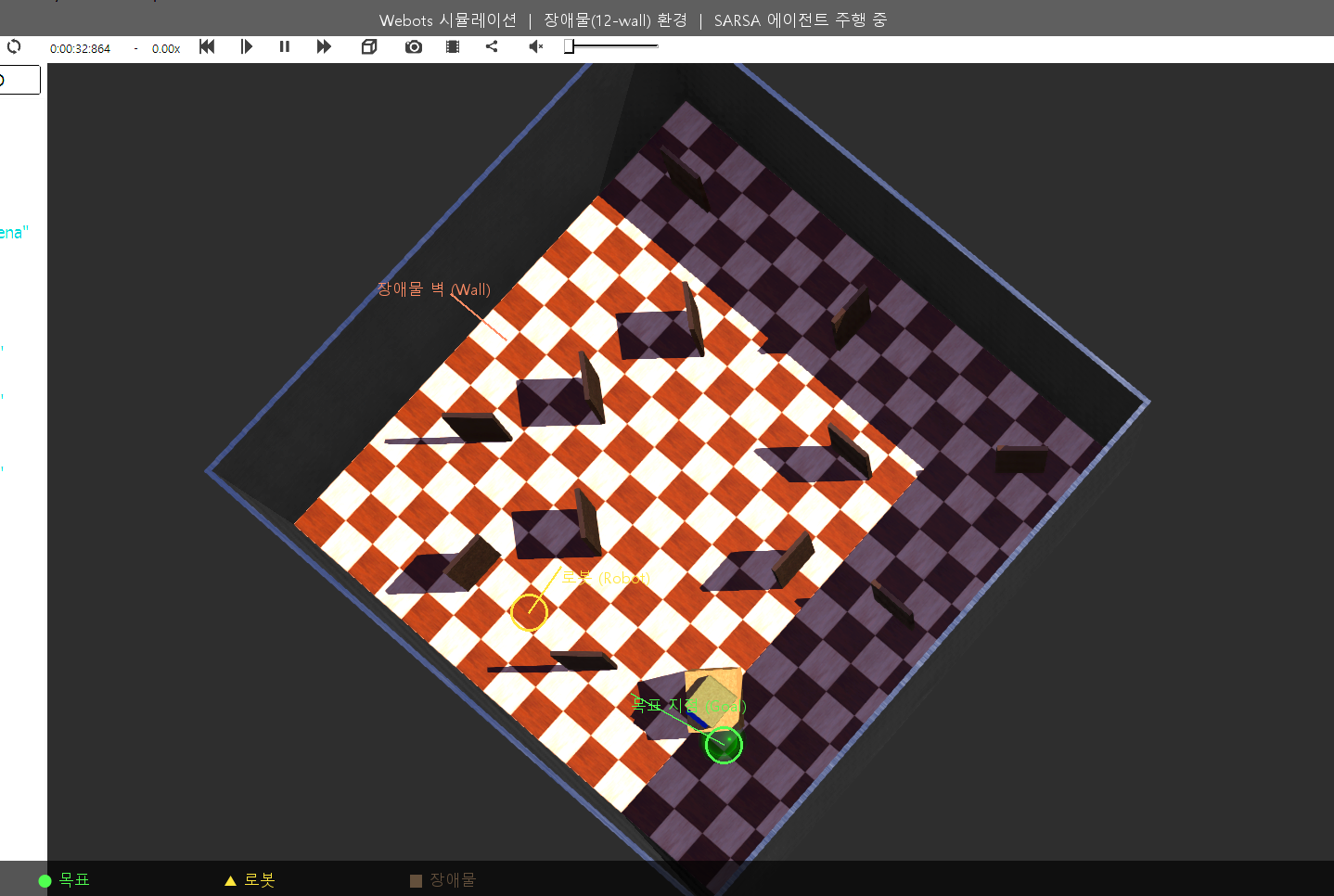
In an empty arena (no_obstacle), navigating is simply a matter of steering toward the target heading. However, introducing 12 interior walls (obstacle12) unveiled a critical bottleneck in reward design:
flowchart TD
    Start["Start (Robot)"]
    Wall["Obstacle Wall"]
    Goal["Target Goal"]

    Start -->|"Direct drive (greedy distance reward)"| Wall
    Wall -.->|"Collision & deadlocked (Local Minima)"| Wall
    Start ==>|"Detour Policy<br>Accepts temporary distance penalty"| Goal
- The Dilemma: When the target is directly on the other side of an interior wall, driving straight ahead leads directly to collision.
- Reward Conflict: Circumnavigating the wall requires moving temporarily away from the goal (negative distance delta). Under naive exploration, the agent enters a deadlock—spinning or timing out against the wall.
2. Solution Strategy: Head-Scan Perception & Value Backpropagation
Overcoming this trap relies on coupling 3-directional head-scan perception with a high discount factor (γ = 0.99):
- Perceptual State Discretization:
- Attempting to advance while
front_distance = Dangeryields a heavy collision penalty (-1.0). - Sweeping the sensor head left and right reveals free avenues (
left_distance = Safeorright_distance = Safe), encouraging lateral turns.
- Attempting to advance while
- Long-Term Temporal Difference Credit Assignment:
- Although turning away temporarily depresses the step reward, successfully rounding the wall and reaching the target yields the substantial terminal reward (+1.0).
- Backpropagated through Q(s, a) with γ = 0.99, the agent gradually learns that detour steps possess higher expected return than head-on approaches.
3. Webots Headless Automation Pipeline
Rigorous reinforcement learning requires multi-seed validation (Seeds 0, 1, 2). Running 1,500 episodes interactively in the Webots GUI three times would take many hours.
We automated this with a headless_run.ps1 PowerShell script, launching Webots in high-speed, no-render mode (--mode=fast --no-rendering):
💻 Automated Pipeline (headless_run.ps1)
# Launch Webots in background headless fast mode
$webotsProc = Start-Process -FilePath $WebotsExe `
    -ArgumentList @("--mode=fast", "--no-rendering", "--stdout", "--stderr", $WorldFile) `
    -PassThru

# Train agent over socket IPC
python train_qlearning.py --scenario obstacle12 --seed 0 --episodes 1500

# Cleanup process and generate performance plots
Stop-Process -Id $webotsProc.Id -Force
python -m qlearning.plot_curves --log-dir logs/obstacle12/seed_0
4. Empirical Evaluation: Cross-Environment Learning Curves
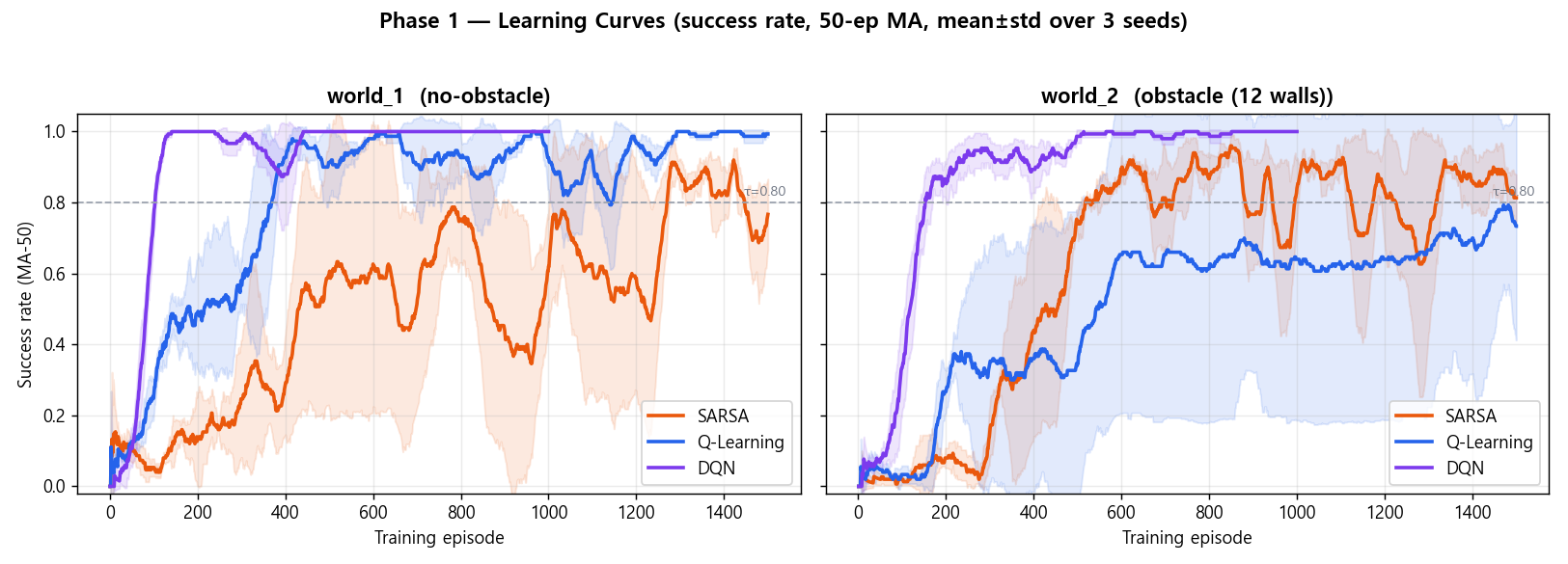
The graph above contrasts convergence across 3 random seeds between the unobstructed world (no_obstacle) and the 12-wall obstacle world (obstacle12).
📊 Benchmark Metrics
| Metric | Empty Arena (no_obstacle) | 12-Wall Arena (obstacle12) |
|---|---|---|
| Initial Convergence | ~300 - 400 episodes | ~600 - 800 episodes |
| Final Success Rate (100-ep MA) | 98.5% - 99.2% | 91.4% - 94.8% |
| Mean Steps per Episode | 15 - 22 steps | 38 - 52 steps (detour path) |
| Cross-Seed Variance | Negligible (highly stable) | Moderate (exploration path dependency) |
- Extended Exploration: In
obstacle12, discovering viable detour corridors requires approximately 200 additional episodes of random trials, keeping the average reward depressed until episode 400. - Detour Mastery: Beyond episode 800, all seeds stabilize above 90% success, confirming that the agent reliably maneuvers through tight gaps without collisions.
5. What's Next?
Our 648-bin Tabular Q-Learning model successfully navigates maze-like obstacle configurations.
In Episode #4, we will load the saved model checkpoints (models/*.npy) to benchmark greedy, deterministic performance using evaluate_qlearning.py and analyze comparative metrics against DQN and SARSA!