[Stanford CS146S #5] Multi-Agent Systems & Swarm Orchestration: Coordinating Autonomous Architect, Implementer, and Critic LLMs

Welcome to Lecture 5 of our deep-dive series covering Stanford University’s CS146S: The Modern Software Developer.
In our previous lectures, we mastered developer prompt engineering, dissected the internal transformer mechanics of coding models, explored tool-use with the Model Context Protocol (MCP), and constructed self-healing spec-driven test harnesses. Each of these paradigms operated under a common implicit assumption: a single primary LLM session interacting with a single developer or IDE workspace.
However, once a software project scales beyond a few thousand lines of code across distributed microservices, the single-agent paradigm fractures. Monolithic agents suffer from context window saturation, attention dilution, and cognitive thrashing.
In today’s lecture, Stanford faculty unveil the future of AI-native engineering: Multi-Agent Systems (MAS) and Swarm Orchestration. We will explore how separating concerns across specialized Architect, Implementer, and Critic roles—coordinated over structured message buses and Directed Acyclic Graphs (DAGs)—delivers order-of-magnitude gains in software generation accuracy and codebase scale.
1. The Scaling Limits of Single-Context Monolithic LLMs
Why can’t we simply hand an entire 500,000-line enterprise repository to a model with a 1-million-token context window and ask it to "refactor the payment billing pipeline"?
Stanford researchers identify three fundamental architectural bottlenecks:
flowchart TD
    subgraph Monolithic_Failure ["The Bottlenecks of Single-Agent Scaling"]
        A1["Massive Context Load (500k+ Tokens)"] --> A2["Attention Dilution & Needle-in-a-Haystack Degradation"]
        A2 --> A3["Instruction Drift: LLM forgets early constraints while reading late files"]

        B1["Single Agent Role Collusion"] --> B2["Self-Confirmation Bias: Generator trusts its own flawed code"]
        B2 --> B3["Hallucination Lock-in: Critic cannot objectively review its own assumptions"]

        C1["Sequential Step Execution"] --> C2["High Latency: Single thread processes tasks serially"]
        C2 --> C3["Context Window Exhaustion: Output token limit reached mid-refactor"]
    end

    subgraph Multi_Agent_Advantage ["The Multi-Agent Swarm Solution"]
        D1["Decomposed Task Graphs (DAG)"] --> D2["Specialized Isolated Contexts (10k tokens each)"]
        D2 --> D3["Parallel Concurrency + Adversarial Verification"]
    end
- Attention Dilution & 'Lost in the Middle': As context windows expand beyond 100k tokens, attention mechanisms exhibit non-uniform retrieval fidelity. Subtle API constraints or database invariants buried in middle files are routinely neglected.
- Role Collusion & Confirmation Bias: When a single LLM acts simultaneously as system designer, coder, and quality assurance tester, it suffers from severe confirmation bias. It rarely invents edge cases that expose its own subtle implementation bugs.
- Context Window Thrashing: Modifying 15 files sequentially in a single chat session pollutes the context buffer with intermediate bash diffs, compiler errors, and discarded hypotheses, quickly exhausting output token budgets.
2. The Tripartite Swarm Architecture: Architect, Implementer, and Critic
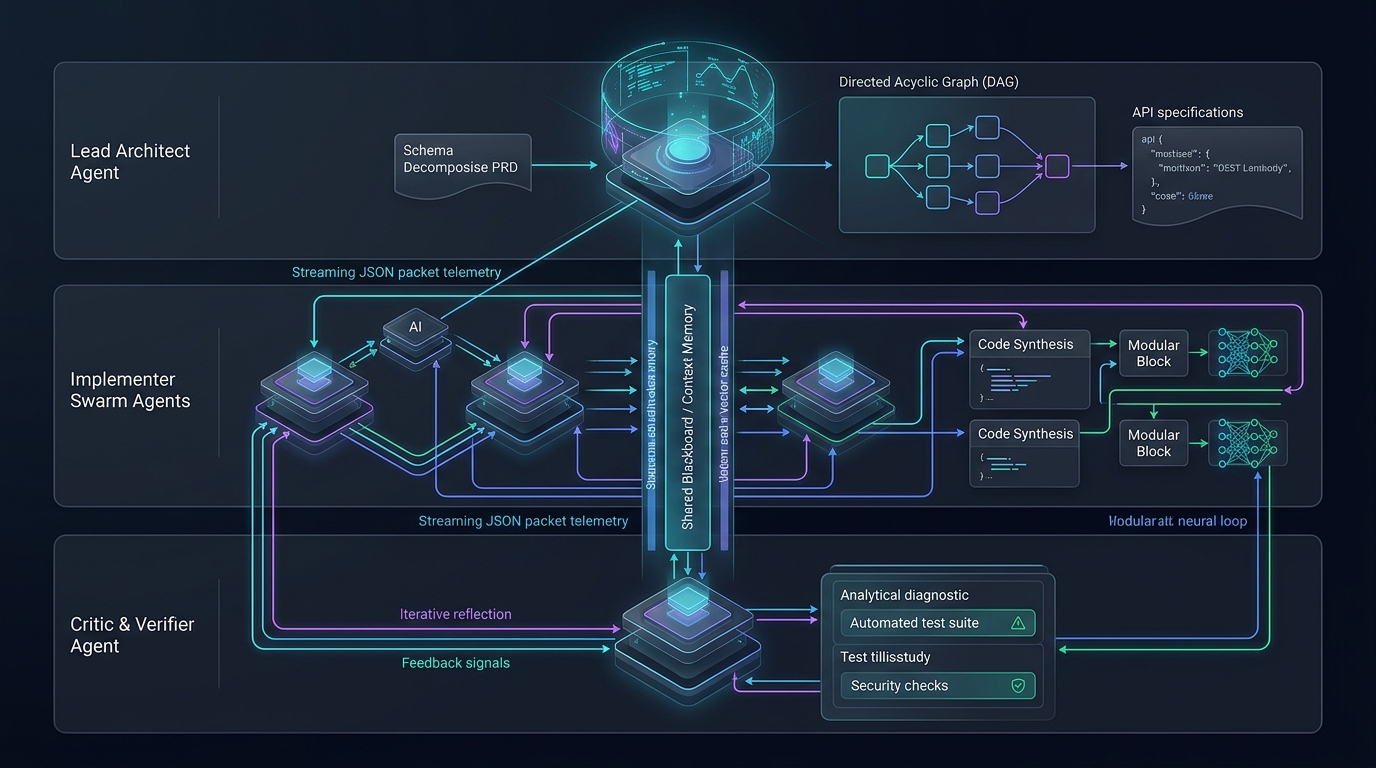
To achieve industrial robustness, Stanford CS146S formalizes the Tripartite Agent Swarm Pattern. Instead of generalist chatbots, we deploy specialized autonomous agents with strictly isolated responsibilities:
flowchart TD
    UserPRD["User Requirements / PRD"] --> Architect["Lead Architect Agent<br/>(System Decomposition & API Schema)"]

    subgraph Swarm_Coordination ["Distributed Agent Swarm"]
        Architect -->|Task DAG & JSON Contracts| Blackboard["Shared Blackboard / State Memory"]

        Blackboard --> WorkerA["Implementer Agent A<br/>(Auth & DB Schema)"]
        Blackboard --> WorkerB["Implementer Agent B<br/>(Payment Gateway API)"]
        Blackboard --> WorkerC["Implementer Agent C<br/>(Webhook Event Handler)"]

        WorkerA -->|Code Patch & Unit Tests| Critic["Adversarial Critic / Verifier Agent<br/>(Security, Linters & Property Tests)"]
        WorkerB -->|Code Patch & Unit Tests| Critic
        WorkerC -->|Code Patch & Unit Tests| Critic
    end

    Critic -->|Rejection & Diagnostic Error Trace| WorkerB
    Critic -->|Verified & All Checks Passed| PR["Automated GitHub Pull Request"]
Role Breakdown:
- The Lead Architect Agent:
- Inputs: User PRD, repository dependency tree, high-level business goals.
- Outputs: A Directed Acyclic Graph (DAG) of decoupled implementation subtasks, strict JSON Schema interfaces, and contract definitions.
- Key Constraint: The Architect writes zero implementation code. Its entire cognitive budget is dedicated to task breakdown and API interface stability.
- The Implementer Agents (Swarm Workers):
- Inputs: A single task slice from the DAG, the API schema contracts, and the localized file tree.
- Outputs: Modular source code, unit test cases, and dependency declarations.
- Execution: Multiple Implementers operate completely concurrently in sandboxed branches or ephemeral containers.
- The Adversarial Critic & Verifier Agent:
- Inputs: The candidate code diff, the original Architect specification, and automated test logs.
- Outputs: Static analysis metrics, security vulnerability scans (AST audit, secret leaks), and a definitive Pass/Fail judgment.
- Feedback Mechanism: Upon failure, the Critic generates an explicit diagnostic diff with stack traces and returns it directly to the offending Implementer for a targeted self-healing cycle.
3. Inter-Agent Communication Topologies
Multi-agent coordination requires strict communication protocols to prevent swarm hallucinations and infinite message loops. CS146S highlights two dominant orchestration topologies:
A. Centralized Blackboard Pattern
In the Blackboard pattern, agents do not message each other directly. Instead, they read from and write to a centralized, validated JSON state store:
{
  "task_id": "TASK-402-AUTH",
  "status": "in_review",
  "dependencies": ["TASK-401-DB-SCHEMA"],
  "assigned_agent": "worker-claude-code-01",
  "contract_schema_hash": "sha256:7f8a92...",
  "artifacts": {
    "patch_path": "/workspace/patches/auth_service.patch",
    "test_coverage": 94.2
  },
  "critic_feedback": null
}
B. Directed Acyclic Graph (DAG) Execution Flow
Rather than unrestricted conversation, agent tasks are modeled as nodes in a DAG where edges denote data dependencies. If Module B depends on Module A's data contract, Implementer B cannot spawn until Implementer A passes Critic verification.
4. Implementation: Building an Asynchronous Swarm Orchestrator in Python
Below is a production-grade asynchronous multi-agent orchestrator implementing the Architect-Implementer-Critic loop using Pydantic structured validation:
# swarm_orchestrator.py - Production Multi-Agent Swarm Engine
import asyncio
from typing import List, Dict, Optional
from pydantic import BaseModel, Field

class SubTaskContract(BaseModel):
    task_id: str
    description: str
    file_targets: List[str]
    interface_schema: Dict[str, str]

class ArchitectPlan(BaseModel):
    plan_title: str
    subtasks: List[SubTaskContract]

class PatchResult(BaseModel):
    task_id: str
    code_diff: str
    unit_tests: str

class CriticAudit(BaseModel):
    passed: bool
    score: float = Field(ge=0.0, le=100.0)
    diagnostic_trace: Optional[str] = None

class SwarmOrchestrator:
    def __init__(self, architect_llm, coder_llm, critic_llm):
        self.architect = architect_llm
        self.coder = coder_llm
        self.critic = critic_llm

    async def execute_task(self, user_prd: str):
        print("[ORCHESTRATOR] Step 1: Synthesizing Architecture Plan...")
        plan: ArchitectPlan = await self.architect.generate_plan(user_prd)

        print(f"[ORCHESTRATOR] Architect decomposed PRD into {len(plan.subtasks)} subtasks.")

        # Concurrently execute subtasks across parallel Implementer workers
        tasks = [self._worker_critic_loop(task) for task in plan.subtasks]
        results = await asyncio.gather(*tasks)

        print("[ORCHESTRATOR] All swarm subtasks successfully verified and integrated!")
        return results

    async def _worker_critic_loop(self, task: SubTaskContract, max_retries: int = 3) -> PatchResult:
        attempt = 0
        error_context = None

        while attempt < max_retries:
            attempt += 1
            print(f"[{task.task_id}] Implementer working (Attempt {attempt}/{max_retries})...")

            patch: PatchResult = await self.coder.implement_task(task, feedback=error_context)

            print(f"[{task.task_id}] Critic auditing patch...")
            audit: CriticAudit = await self.critic.verify(task, patch)

            if audit.passed:
                print(f"[{task.task_id}] PASSED verification (Score: {audit.score}/100)!")
                return patch

            print(f"[{task.task_id}] REJECTED by Critic: {audit.diagnostic_trace}")
            error_context = audit.diagnostic_trace

        raise RuntimeError(f"Task {task.task_id} failed to pass Critic review after {max_retries} cycles.")
5. Key Lecture Takeaways & Next Steps
- Monolithic Agents Don't Scale: Context window saturation and self-confirmation bias necessitate decomposing software development into modular multi-agent swarms.
- Tripartite Specialization: Strictly decouple the Architect (system decomposition and interface schemas), the Implementer (sandboxed concurrent coding), and the Critic (adversarial verification and AST auditing).
- Structured Coordination: Rely on Directed Acyclic Graphs (DAGs) and validated JSON Blackboard state stores rather than chaotic free-form conversational chatter.
In Lecture 6, we will explore AI-Assisted Debugging and Profiling: Leveraging eBPF, Dynamic Tracing, and LLMs for Runtime Incident Mitigation.
📌 3–5 Line Executive Summary
- Multi-Agent Scaling Imperative: Solved monolithic LLM failure modes—attention dilution, instruction drift, and confirmation bias—by replacing single-session prompts with multi-agent swarms.
- Tripartite Agent Separation: Formalized the Architect (DAG planning & API contracts), Implementer (concurrent modular coding), and Critic (adversarial testing & security auditing) tripartite workflow.
- Deterministic Communication Protocols: Prevented swarm hallucinations through structured Pydantic JSON schemas, centralized Blackboard state stores, and DAG-constrained execution graphs.
- Resilient Self-Healing Loops: Architected asynchronous retry loops where Critic diagnostic traces automatically guide Implementer patch refinement until full regression test clearance.
References & Stanford CS146S Materials
- Course: Stanford CS146S (The Modern Software Developer), Spring/Fall 2026.
- Instructors: Dept. of Computer Science, Stanford University.
- Related Frameworks: LangGraph, AutoGen, CrewAI, Anthropic Multi-Agent Orchestration Protocols.