Public Budget AI #5: 6-Sector Audit Suite & Year-End Dumps

📌 Key Takeaways
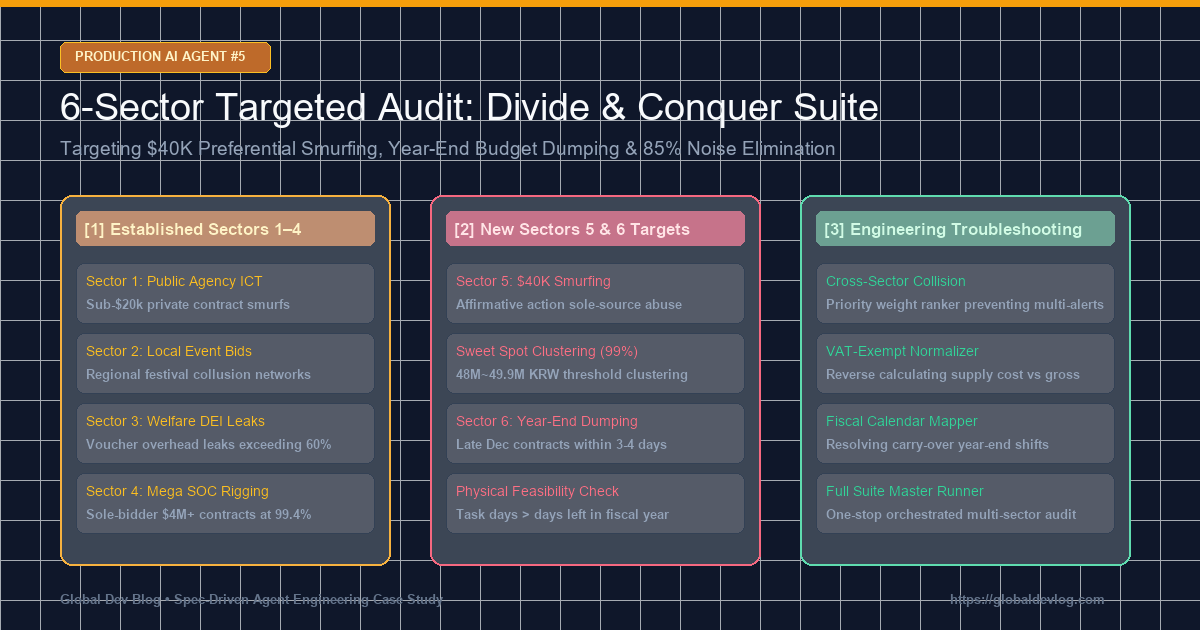
- Divide & Conquer Full Suite: Filtering 85% routine consumables across 4 million public contracts, we expanded our targeted surveillance pipeline to encompass 6 high-risk sectors (Sectors 1–6) covering structural public corruption corridors.
- Unmasking 2 Elusive Blind Spots:
- Sector 5 ($40K Preferential Smurfing): Exploiting statutory affirmative action ceilings ($40,000 / 50M KRW) by clustering split contracts at $39,000 (99.0% threshold proximity), catching $180,000 in evasive awards.
- Sector 6 (December Fiscal Dumping): Rushing $120,000 across 3 consecutive sole-source awards within 4 days in late December to avoid budgetary clawbacks.
- 2 Preempted Architectural Hurdles:
- Built a Sweet Spot (96–99.8%) Proximity Engine distinguishing genuine social enterprise support from artificial splitting.
- Designed Temporal Density & Task Feasibility Analyzers distinguishing standard year-end settlements from rushed dumping where completion is physically impossible.
- 3 Real Production Bugs Resolved: Multi-sector classification collisions resolved via priority weighting, VAT gross/net confusion fixed by reverse-calculating supply costs, and fiscal year carry-over date shifts resolved.
⚠️ Legal Notice & Anonymization
[Notice] All entities, contract identifiers, and locations in this report are strictly anonymized.
To protect organizational reputations and prevent disputes, all public authorities (e.g.,Agency A,Agency C), vendors (Company D,Company F), personal names, and contract IDs have been masked and pseudonymized.
Introduction: What Happens When You Only Monitor the $20K Threshold?
In Part 3, we introduced our 3D Sector Partition Manager, which eliminates 85% of routine procurement noise to focus computational power on Sector 1 (ICT contracts under $20K).
However, working with professional auditors revealed a cat-and-mouse dynamic:
"When corrupt networks realize automated monitors watch the $20K threshold, they migrate behind higher legal exemptions. The most notorious loopholes are $40K affirmative action exemptions (for social and minority-owned enterprises) and late December fiscal dumping, where agencies rush contracts within 3 to 4 days to prevent unspent funds from returning to the National Treasury."
Naive threshold checks cannot catch these evasion strategies. To close these corridors, we scaled the architecture into a comprehensive 6-Sector 'Divide & Conquer' Audit Suite.
1. The 6-Sector Divide & Conquer Architecture
flowchart TD
    Raw[4 Million Public Contracts / Year] --> Filter{3D Sector Partition Manager<br/>Agency × Item × Method}

    Filter -->|85% Routine Supplies| Drop[Low-Risk Pass-Through Archive]

    Filter --> S1["Sector 1: Public Agency ICT <$20K Smurfing"]
    Filter --> S2["Sector 2: Local Event Agency Collusion"]
    Filter --> S3["Sector 3: Welfare DEI Overhead Leakage"]
    Filter --> S4["Sector 4: Mega SOC Rigging (>99% Bid Ratio)"]
    Filter --> S5["🔴 Sector 5 (New): $40K Preferential Smurfing"]
    Filter --> S6["🔴 Sector 6 (New): Late December Budget Dumps"]

    S1 & S2 & S3 & S4 & S5 & S6 --> Master[All Sectors Master Runner<br/>ALL_SECTORS_COMPREHENSIVE_AUDIT_2026.md]

    style Filter fill:#fefce8,stroke:#eab308,stroke-width:2px
    style S5 fill:#fee2e2,stroke:#ef4444,stroke-width:2px
    style S6 fill:#fee2e2,stroke:#dc2626,stroke-width:2px
    style Master fill:#eff6ff,stroke:#3b82f6,stroke-width:2px
2. Preempted Engineering Challenges
🎯 Challenge 1: Legitimate Policy Ceiling vs. Artificial Smurfing
- Problem: Under state contracting laws, minority and social enterprises qualify for sole-source awards up to $40,000 (50M KRW). An indiscriminate check on $20K–$40K contracts flags thousands of legitimate social programs, creating false positives.
- Preemptive Architecture:
- We engineered a Sweet Spot Proximity Engine:
Threshold Proximity = (Contract Amount / 50,000,000 KRW) * 100 - The system triggers high-risk alerts only when contract amounts cluster at 96.0%–99.8% ($38,500–$39,900) AND the same buyer-seller pair executes multiple related awards within 30 days.
- We engineered a Sweet Spot Proximity Engine:
🎯 Challenge 2: Normal December Settling vs. Rushed Fiscal Dumps
- Problem: Public agencies routinely clear backlogs and issue final milestone payments in December. Treating all December volume spikes as anomalies causes annual alert floods.
- Preemptive Architecture:
- We implemented Temporal Density and Task Feasibility Inversion:
- Density: Flags vendors receiving multiple sole-source awards clustered within 3–4 days after December 15th.
- Physical Impossibility: Evaluates whether the days remaining until December 31st (e.g., 4 days) are physically sufficient to execute complex research or development work typically requiring months.
- We implemented Temporal Density and Task Feasibility Inversion:
3. Resolving 3 Unexpected Production Bugs
🚨 Bug 1: Cross-Sector Boundary Collisions & Duplicate Alerts
- Symptom: A single ICT contract awarded to a minority firm in late December simultaneously triggered alerts in Sector 1, Sector 5, and Sector 6, flooding auditors with 3 redundant dossiers.
- Root Cause: Each sector filter operated as an independent pipeline without central collision resolution.
- Fix: Implemented an
AuditSectorPriority Weight Ranker, assigning the primary sector based on statutory punitive severity (Special Exemption Abuse > Fiscal Dumping > Routine Sub-$20K) while merging other traits into secondary metadata tags.
🚨 Bug 2: VAT Gross vs. Net Exemption Dropouts
- Symptom: An evident 50M KRW smurfing case ($39,500 net) failed to trigger Sector 5 alarms.
- Root Cause: Statutory thresholds evaluate supply prices excluding VAT, but the procurement API transmitted gross prices including 10% VAT ($43,450 gross). Simple numeric comparisons classified it as an open competitive bid, dropping it from the sole-source monitor.
- Fix: Built a
VAT-Exempt Normalizerreverse-calculating net supply prices prior to running proximity calculations:
def normalize_estimated_price(contract_amount: int, is_vat_included: bool = True) -> int:
    """
    Computes statutory estimated prices excluding VAT,
    preventing tax inclusive payloads from evading threshold monitors.
    """
    if is_vat_included and contract_amount > 0:
        return int(round(contract_amount / 1.1))
    return contract_amount
🚨 Bug 3: Fiscal Year Carry-Over Date Parsing Shifts
- Symptom: Emergency spending contracts executed in early January under fiscal carry-over authorities fell outside December date filters.
- Fix: Built a
FiscalCalendarNormalizeraligning contract dates with statutory settlement windows rather than strict calendar months.
4. Field Results: 50M KRW Smurfing & Year-End Dumps Unmasked
🕵️ Sector 5 Case: Artificial Smurfing Below the $40K Ceiling
- Target Entity:
Agency Aawarding contracts toCompany D. - Modus Operandi:
- Award 1 (May 10): $39,600 (Threshold Proximity: 99.0%)
- Award 2 (May 18): $39,360 (Threshold Proximity: 98.4%)
- Award 3 (May 25): $39,120 (Threshold Proximity: 97.8%)
- Totaling $118,080 over 15 days, intentionally partitioned below the $40,000 threshold. Matched Board of Audit precedent
BAI-2023-072.
🕵️ Sector 6 Case: 3 Contracts in 4 Days Before Budget Cutoff
- Target Entity:
Agency Cawarding contracts toCompany F. - Modus Operandi:
- Dec 22: Environmental Database Contract 1 ($28,000)
- Dec 24: Environmental Database Contract 2 ($33,600)
- Dec 26: Policy Implementation Report ($38,400)
- Totaling $100,000 rushed across 4 days immediately prior to December 31st closure, making genuine quality inspection physically impossible. Matched
BAI-2022-094.
5. Verification: Master Orchestrator (17/17 PASS)
Using tools/run_all_sectors_audit.py, all 6 sectors execute as a unified automated pipeline, writing comprehensive dossiers to reports/ALL_SECTORS_COMPREHENSIVE_AUDIT_2026.md with 17/17 test suites passing cleanly.
6. Conclusion: Closing the Loopholes with Targeted Partitioning
Corrupt cartels survive on legal boundaries. When they discover small-contract monitors, they retreat behind affirmative action exemptions or holiday deadlines.
By modeling statutory edge cases mathematically, our 6-sector architecture closes these loopholes.
In our final installment (Part 6), we will present the full-stack engineering of Inspector Web Portal v3.0, unifying real-time graph visualization, case law search, and automated summons!