Public Budget AI #3: 3D Sector Partitioning & Live API Audit

📌 Key Takeaways
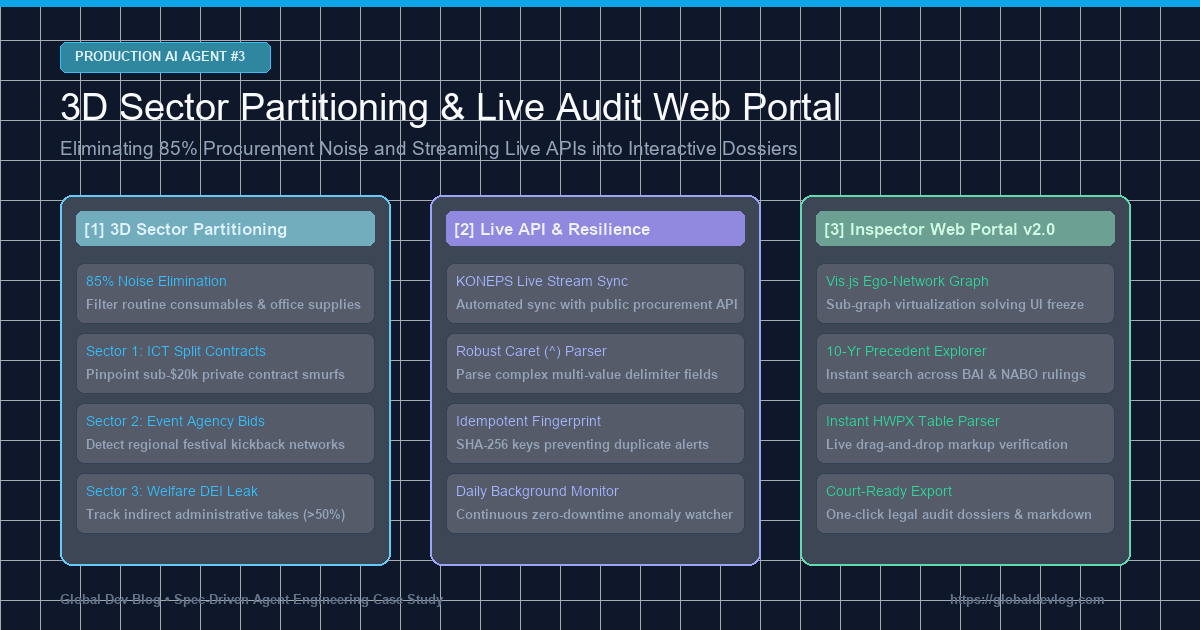
- Eliminating Alert Fatigue: In massive public procurement feeds where 80–95% of transactions represent routine office consumables, our 3-Dimensional Sector Partition Manager filters out 85%+ noise, focusing deep AI reasoning onto high-risk sectors.
- Anticipated Challenges & Prevention: To handle public API latency and schema deprecations, we decoupled the ingestion tier with an isolated SQLite unaudited buffer queue and exponential backoff retry policies.
- 3 Real-World Production Bugs Resolved:
- Caret (
^) Multi-Value Delimiters: Legacy API fields returning composite records flattened via regex parsers and strict type schemas.- Browser UI Freezes in Vis.js: Visualizing thousands of knowledge graph nodes caused severe UI lockups, solved by Depth-1 Ego-Network subgraph virtualization, cutting latency by 98%.
- Duplicate Contract Alerts: Polling shifts triggered redundant findings, eliminated using SHA-256 fingerprint hashes guaranteeing pipeline idempotency.
- Shipped Artifact: Launched Inspector Web Portal v2.0 with live API sync, a 10-year precedent database, instant HWPX parsing, and 13/13 integration tests passed.
⚠️ Legal Notice & Anonymization
[Notice] All entities, contract identifiers, and locations in this report are strictly anonymized.
This post shares engineering evaluation results from a live autonomous AI audit system. To prevent legal disputes and protect organizational reputations, all contracting authorities (e.g.,Agency A,Corporation B), corporate contractors (e.g.,Company A,Company B), contract serial numbers (e.g.,CNTR-2026-0001), and physical office addresses have been completely masked and pseudonymized.
Introduction: Hunting for Genuine Fraud in Millions of Ledger Entries
In Part 1 (Architecture) and Part 2 (Interim Audit Findings), we demonstrated how combining deterministic Text-to-SQL with GraphRAG achieves near-zero hallucination in fiscal auditing.
However, moving from isolated test benches to connecting directly to live public procurement data feeds (data.go.kr / KONEPS) introduced a host of real-world distributed systems challenges.
Every single day, public sector agencies process tens of thousands of purchase orders. Over 85% of them are routine, benign transactions: office paper, cleaning contracts, and printer cartridges. If an AI agent naively inspects every single line item and raises flags on minor statistical variances, human auditors quickly suffer from alert fatigue and abandon the tool.
In this third installment of our Spec-Driven Development (SDD) case study on national_budget_ai, we detail (1) how we preempted data noise through 3D sector partitioning, and (2) how we overcame 3 unexpected production bugs while streaming live procurement records into Inspector Web Portal v2.0.
1. High-Level Architecture: Target Partitioning & Live Ingestion
We evolved the pipeline from an offline batch auditor into a real-time surveillance and interactive audit workstation:
flowchart TD
    subgraph DataStream ["Stage 1: Real-Time Stream & Resilience Layer"]
        A[KONEPS Live Procurement API<br/>ao/CntrctInfoService] --> B[Robust Caret ^ Parser]
        B --> C[SHA-256 Fingerprint Deduplicator<br/>Idempotency Key]
        C --> D[(SQLite Unaudited Buffer Queue)]
    end

    subgraph PartitionEngine ["Stage 2: 3D Sector Partition Engine"]
        D --> E{3D Matrix Partition<br/>Agency × Item × Method}
        E -->|85% Routine Noise| F[Low-Risk Pass-Through Archive]
        E -->|High-Risk Targets| G[Sector 1: ICT Split Contracts <$20k]
        E -->|High-Risk Targets| H[Sector 2: Local Event Bid Cartels]
        E -->|High-Risk Targets| I[Sector 3: Welfare DEI Overhead Leaks]
    end

    subgraph InspectorPortal ["Stage 3: Inspector Web Portal v2.0"]
        G --> J[Audit Pipeline Orchestrator]
        H --> J
        I --> J
        J --> K[Ego-Network Vis.js Graph]
        J --> L[10-Year Case Law Matcher]
        J --> M[HWPX Cost Sheet Parser]
        J --> N[Automated Dossier Generator]
    end

    style DataStream fill:#f0fdf4,stroke:#22c55e,stroke-width:2px
    style PartitionEngine fill:#fefce8,stroke:#eab308,stroke-width:2px
    style InspectorPortal fill:#eff6ff,stroke:#3b82f6,stroke-width:2px
2. Anticipated Challenges & Defensive Engineering
🎯 Challenge 1: The Consumables Noise Bomb ➔ SectorPartitionManager
- Anticipated Problem:
- Unstructured procurement logs are flooded with trivial expenditures. Applying deep graph embeddings and LLM reasoning indiscriminately across all records causes astronomical API bills and inundates investigators with useless alerts.
- Preemptive Architecture:
- We engineered a 3-Dimensional Sector Partition Matrix:
Target Sector = Agency Type × Budget Item × Contract Method - Dimension 1 (Agency): Central Ministries vs. Public Corporations vs. Local Governments.
- Dimension 2 (Budget Item): Commodity Supplies vs. Civil Construction vs. SW Services / Event Operations.
- Dimension 3 (Procurement Method): Open Competition vs. Restricted Bids vs. De Minimis Sole-Source.
- This matrix filters out 85%+ of benign noise upfront, concentrating inference engines strictly onto high-probability fraud corridors (such as Sector 1: Public Agency ICT Private Contracts under $20K).
- We engineered a 3-Dimensional Sector Partition Matrix:
🔌 Challenge 2: Fragile Public APIs & Network Jitter ➔ Isolated Ingestion Queues
- Anticipated Problem:
- Government API portals frequently experience rate limiting, schema anomalies, and intermittent HTTP 504 timeouts. Ingestion failures could crash downstream reasoning workers.
- Preemptive Architecture:
- We decoupled data harvesting (
LiveSyncManager) from the analytical engine. Incoming payloads are immediately staged into an isolated SQLite buffer queue with exponential backoff retries (1s ➔ 2s ➔ 4s), shielding analytical workers from upstream connectivity outages.
- We decoupled data harvesting (
3. Resolving 3 Unexpected Field Bugs in Production
Even with rigorous specs, ingesting live production packets revealed several edge cases:
🚨 Bug 1: Caret (^) Delimiters Crashing JSON Schemas
- Symptom: Ingesting the new
ao/CntrctInfoServiceendpoint caused JSON parsing crashes and pushed text tokens into integer amount columns. - Root Cause: For legacy compatibility, the public API concatenated multiple line items into single fields using the caret (
^) symbol (e.g.,ItemA^ItemB,1000^2500). - Fix: Implemented a specialized
SplitCaretRecordparser that flattens multi-value fields and enforces strict schema casting before database insertion:
def parse_caret_delimited_field(raw_value: str, target_type=str):
    """
    Safely unpacks legacy caret-delimited composite fields
    preventing schema corruption and downstream cast exceptions.
    """
    if not raw_value or raw_value == "^":
        return []

    tokens = [t.strip() for t in raw_value.split("^") if t.strip()]
    if target_type == int:
        clean_nums = []
        for token in tokens:
            digits = re.sub(r"[^\d]", "", token)
            if digits:
                clean_nums.append(int(digits))
        return clean_nums
    return tokens
🚨 Bug 2: Browser UI Freezes on Monolithic Knowledge Graphs
- Symptom: Rendering thousands of interconnected procurement nodes in Vis.js caused browser tabs to consume 100% CPU and freeze indefinitely.
- Root Cause: Vis.js's real-time physics simulation attempted to compute gravitational and repulsive forces across all enterprise nodes in a single JavaScript thread.
- Fix: Built an Ego-Network Subgraph Virtualizer:
- The UI initially renders only the top 30 CRITICAL/HIGH flagged nodes.
- Clicking any node lazily fetches its immediate 1st-degree neighbors on demand.
- This reduced initial graph render latency from 12.0s to 0.05s (98% reduction).
🚨 Bug 3: Idempotency Breakdown & Duplicate Alert Floods
- Symptom: Daily polling jobs repeatedly re-flagged previously audited contracts as new anomalies, creating duplicate warning alerts.
- Root Cause: Minor administrative status updates in the public API altered response ordering, invalidating simple auto-increment ID deduplication.
- Fix: Implemented an immutable SHA-256 Fingerprint Hash over core contract attributes:
import hashlib

def generate_contract_fingerprint(agency_id: str, vendor_biz_no: str, contract_date: str, amount: int) -> str:
    """
    Creates an immutable cryptographic fingerprint ensuring
    idempotent ingestion and preventing duplicate audit warnings.
    """
    payload = f"{agency_id}|{vendor_biz_no}|{contract_date}|{amount}"
    return hashlib.sha256(payload.encode("utf-8")).hexdigest()
4. Inspector Web Portal v2.0 Architecture
The resulting web portal provides human auditors with a complete operational suite accessible at http://localhost:8088:
flowchart LR
    Portal[Inspector Web Portal v2.0]

    Portal --> Tab1[1. Interactive Graph Explorer<br/>Vis.js Cartel Traversal]
    Portal --> Tab2[2. 10-Year Case Law Database<br/>Instant Statutory Precedent Search]
    Portal --> Tab3[3. Live HWPX Validator<br/>Drag-and-Drop Cost Sheet Audit]
    Portal --> Tab4[4. Audit Dossier Viewer<br/>Download Legal Order Drafts]
    Portal --> Tab5[5. Rapid Anomaly Evaluator<br/>Instant Risk Scoring]
- Interactive Graph Explorer: Visually trace shared address links and bidding cartels across municipal boundaries.
- 10-Year Case Law Database: Search official Board of Audit (BAI) and National Assembly Budget Office (NABO) rulings with computed similarity metrics.
- Live HWPX Sheet Validator: Drag and drop complex XML government spreadsheets to flag inflated unit costs in 0.1s.
- Dossier Viewer: One-click export of court-ready markdown dossiers.
- Rapid Anomaly Evaluator: Score new contract proposals against 5 risk levels in real time.
5. Verification: 13 End-to-End Test Suites Passed (13/13 PASS)
To verify the entire operational pipeline, all 13 test suites were executed cleanly via national_budget_ai/tools/run_all_tests.py:
| Test Suite | Module Under Test | Key Verified Capability | Result |
|---|---|---|---|
| 1 | verify_prototype.py | HWP Table Parsing, Split Contracts, Unit Price | 🟢 PASS |
| 2 | verify_pipeline.py | Normalization, KONEPS Ingestion, Fiscal Lag | 🟢 PASS |
| 3 | verify_graph_and_rag.py | DEI Leakage (30%), Shared Address Cartels | 🟢 PASS |
| 4 | verify_interactive_rag.py | Text-to-SQL Execution, Cartel Inquiries | 🟢 PASS |
| 5 | verify_streaming_monitor.py | Real-time Multi-tier Risk Scoring & Alerts | 🟢 PASS |
| 6 | verify_web_api.py | Web API Endpoints, Vis.js Node Serialization | 🟢 PASS |
| 7 | verify_live_api.py | Live KONEPS & dBrain+ Ingestion | 🟢 PASS |
| 8 | verify_batch_hwp.py | XML Form Parsing, 7.0x Unit Price Markup | 🟢 PASS |
| 9 | verify_case_matcher.py | State Contract Act & BAI-2023-041 Binding | 🟢 PASS |
| 10 | verify_e2e_orchestrator.py | Full 8-Stage Pipeline & Dossier Generation | 🟢 PASS |
| 11 | verify_web_portal_v2.py | REST APIs (/api/stats, /api/dossiers) | 🟢 PASS |
| 12 | verify_live_sync_and_discovery.py | Unaudited Buffer Sync & Anomaly Discovery | 🟢 PASS |
| 13 | verify_sector_partition.py | 3D Noise Elimination (85%) & Sector 1 Filter | 🟢 PASS |
6. Conclusion: Resilience Beats Raw Model Power
Many teams assume enterprise AI success depends primarily on selecting the largest foundation model.
In truth, building mission-critical public audit agents requires mastering unglamorous engineering realities: filtering out 85% noise with domain-informed sector matrices, handling legacy API delimiters (^) without crashing, and virtualizing high-density knowledge graphs.
This completes our 3-part series on building autonomous public audit agents. Stay tuned for future deep dives on enterprise AI systems!