Stanford CS329A (Ep 11): Agent Memory — MemGPT, Cartridges, CacheBlend, and Long-Horizon Context Architecture

When developers deploy autonomous AI agents as long-term collaborators or autonomous engineering partners, they inevitably run into three frustrating architectural bottlenecks:
- "The agent forgets critical architectural decisions agreed upon in yesterday's session."
- "Stuffing a 100,000-line enterprise codebase into a million-token context window causes severe attention degradation (the Lost-in-the-Middle phenomenon) and inflates inference bills into thousands of dollars."
- "Combining multi-document retrieval chunks in RAG serving invalidates prefix key-value caches, sending Time-To-First-Token (TTFT) soaring into several seconds."
Human cognition solves this effortlessly. Biological brains possess a severely constrained working memory (holding only about 4 to 7 discrete chunks), yet effortlessly retrieve memories from decades ago and rapidly integrate cross-domain knowledge without retraining or cognitive paralysis.
In this continuation of Part 3: Agent Engineering of Stanford CS329A: Self-Improving AI Agents, we explore Agent Memory Architecture — how modern artificial intelligence grants autonomous systems persistent, hierarchical memory across three distinct abstraction tiers:
- The Software Control Tier (MemGPT, UC Berkeley 2023): OS-inspired hierarchical virtual memory paging.
- The Neural Representation Tier (Cartridges, 2025): Self-Study context distillation compressing massive documents into modular, plug-and-play continuous KV vectors.
- The Systems Infrastructure Tier (CacheBlend, EuroSys 2025): Selective KV cache recomputation restoring cross-attention and slashing RAG latency by 3.3x.
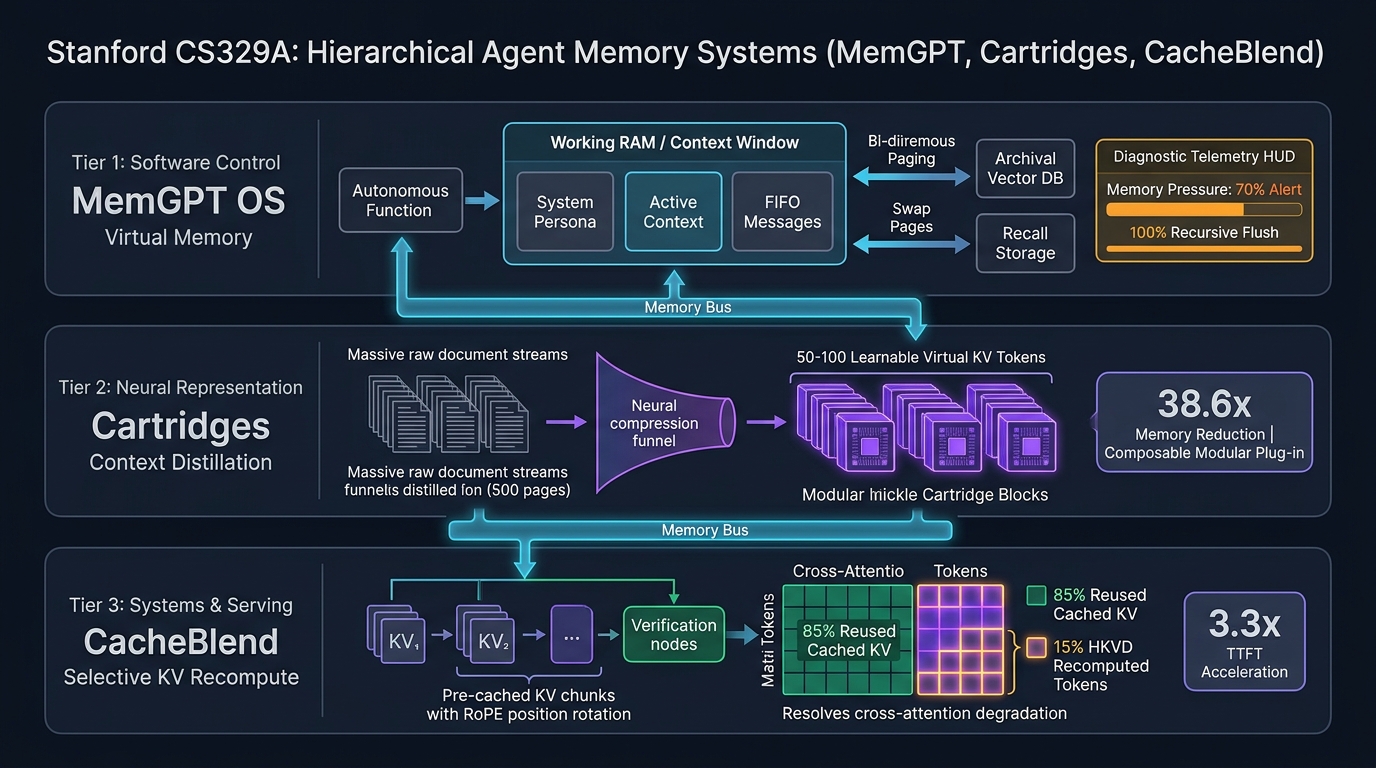
1. The Long-Horizon Context Dilemma
Simply extending an LLM's physical context window (e.g., from 8k to 1M+ tokens) does not solve agent memory. In fact, brute-force context scaling introduces severe thermodynamic and algorithmic failure modes:
- Attention Dissipation & Lost-in-the-Middle: Transformer self-attention scales quadratically in compute $O(N^2)$ without optimizations, and attention distribution flattens, causing models to misplace subtle factual needles buried in the middle of massive prompts.
- Economic Infeasibility: Continuously resending 500k-token prompts on every single conversational turn burns through compute budgets exponentially.
- Static Invariance: When a prompt ends, the model's transient activations vanish. The agent cannot autonomously update its internal state without external intervention.
To achieve persistent autonomy, we must decouple Working Context from Long-Term Storage through structured Hierarchical Context Management.
┌─────────────────────────────────────────────────────────────────────────┐
│              The 3-Tier Agent Memory Abstraction Stack                  │
└────────────────────────────────────┬────────────────────────────────────┘
                                     │
       ┌─────────────────────────────┼─────────────────────────────┐
       ▼                             ▼                             ▼
┌──────────────────────────┐  ┌──────────────────────────┐  ┌──────────────────────────┐
│   Software Control Tier  │  │ Neural Representation Tier│  │  Systems Infrastructure  │
│         (MemGPT)         │  │       (Cartridges)       │  │       (CacheBlend)       │
├──────────────────────────┤  ├──────────────────────────┤  ├──────────────────────────┤
│ • OS-Style Virtual Paging│  │ • Self-Study Distillation│  │ • Multi-Chunk RAG Merging│
│ • Main Context (RAM)     │  │ • Continuous KV Embeddings│ │ • Selective KV Recompute │
│ • Archival Vector (Disk) │  │ • 38.6x Memory Reduction │  │ • Top 15% HKVD Recompute │
│ • Autonomous Eviction    │  │ • 26.4x Throughput Boost │  │ • RoPE Alignment Matrix  │
│ • Deep Memory Recall 92% │  │ • Modular Composability  │  │ • 3.3x TTFT Latency Drop │
└──────────────────────────┘  └──────────────────────────┘  └──────────────────────────┘
2. Software Control Tier: MemGPT (UC Berkeley 2023)
Operating systems mastered memory constraints decades ago. A modern operating system provides programmers with the illusion of unlimited RAM by transparently swapping virtual memory pages between high-speed physical DRAM and high-capacity storage disks via the Memory Management Unit (MMU).
Developed by Packer et al. at UC Berkeley, MemGPT Long-Term Memory brings classic OS virtual memory management directly into language agent architectures:
"The LLM's prompt window is physical RAM. External vector databases and relational message logs are the hard drive. By equipping the model with function-calling primitives to inspect, edit, flush, and recall memory, the agent becomes its own operating system."
    ┌────────────────── [Main Context (RAM: 8k~128k Token Window)] ────────────────┐
    │ 1. System Instructions : Core agent identity and memory management manual   │
    │ 2. Working Context     : Static facts, persona traits, and user profile (R/W)│
    │ 3. FIFO Message Queue  : Recent dialogue + Recursive Summary Header          │
    └─────────────────────────────────────────────────────────────────────────────┘
                               ▲                      │
                (Swap-In / Search)                    │ (Swap-Out / Evict & Flush)
                               │                      ▼
    ┌───────────────── [External Context (Disk: Infinite Storage)] ───────────────┐
    │ 1. Recall Storage   : Timestamped raw conversation history (PostgreSQL)     │
    │ 2. Archival Storage : Deep knowledge repository & document embeddings (HNSW) │
    └─────────────────────────────────────────────────────────────────────────────┘
Autonomous Memory Paging Mechanics
Unlike standard RAG architectures where hardcoded Python scripts prepend search snippets, MemGPT grants the agent self-directed memory control:
- Memory Pressure Warning (70% Threshold):
- When incoming dialogue occupies 70% of the active context window, a system interrupt is queued:
"System Alert: Context window at 70% capacity. Review recent history and persist critical facts into working_context before eviction."
- Recursive Summarization & Eviction (100% Flush):
- Upon reaching 100% capacity, the FIFO queue manager evicts the oldest 50% of the conversation.
- Crucially, raw messages are not discarded. MemGPT invokes a Recursive Summarization routine, blending the existing historical summary with newly evicted tokens to create an updated, high-density summary block at the queue head.
- The evicted raw message objects are moved to permanent
Recall Storage.
- Autonomous Heartbeat Recall:
- When a user asks about an event from months ago, the model queries
recall_storage.search()and setsrequest_heartbeat=true. This allows the agent to chain multiple tool calls autonomously, pulling disk records into working RAM before delivering a final answer.
- When a user asks about an event from months ago, the model queries
Empirical Benchmarks
On the Deep Memory Recall (DMR) benchmark spanning dozens of extended conversational sessions:
- Standard GPT-4 with a static context window plummeted to 32.1% accuracy.
- MemGPT achieved 92.5% accuracy, maintaining zero performance degradation regardless of how many sessions elapsed.
- In Nested Key-Value Retrieval, where agents must follow multi-hop associative chains ($K_1 \to V_1 / K_2 \to V_2$), baseline models collapsed to 0% beyond 3 hops, while MemGPT sustained 100% precision.
3. Neural Representation Tier: Cartridges (2025)
While MemGPT manages memory at the token level, moving thousands of text tokens back and forth remains computationally expensive. If an enterprise agent must reference a 500-page financial disclosure or an entire SDK codebase, loading raw text consumes massive memory and incurs extreme prefill latency.
Introduced in 2025, Cartridges Modular Agent Memory asks a radical question:
"Why represent knowledge with bulky text tokens? What if an LLM could study a 500-page document offline and distill it into 50 to 100 continuous, learnable Key-Value cache vectors that can be plugged into the model like a physical ROM cartridge?"
[500-Page Document / Codebase]
             │
             ▼ (Self-Study Pipeline)
1. Synthetic Dialogue Synthesis (Summary, Questions, Use-Cases, Constraints)
             │
             ▼
2. Context Distillation via KL-Divergence:
   Teacher Model (Raw 500-Page Document + Query) ──► P_Teacher(y)
                                                        │ (D_KL Loss)
   Student Model (Cartridge Z [50 KV Tokens] + Query) ─► P_Student(y)
             │
             ▼
[Plug-and-Play Cartridge Z (50~100 Continuous KV Vectors)]
(38.6x Memory Compression, 26.4x Throughput Acceleration, Modular Composability)
Why Naive Next-Token Prediction Fails
When researchers initially attempted to optimize continuous KV tokens using standard Next-Token Prediction (NTP) on raw text, the model suffered from "Rote Memorization Syndrome":
- It could recite exact paragraphs verbatim from start to finish.
- However, when prompted to answer conceptual or analytical questions about the text, accuracy collapsed to zero. The representations were memorized surface tokens, not accessible semantic knowledge.
The Self-Study & Context Distillation Architecture
To overcome this, the authors engineered a two-stage Self-Study training regimen:
- Diverse Synthetic Dialogue Generation: The model generates thousands of multi-turn Q&A pairs across five archetypes: structural outlines, deep thematic questions, edge-case use cases, and creative synthesis.
- Context Distillation:
- Teacher Model: Receives the entire 500-page raw text in its context window and outputs target probability distributions
P_Teacher(y | Doc, x). - Student Model: Receives only the compact Cartridge parameters $Z$ (50-100 virtual KV tokens) and query $x$.
- The cartridge parameters $Z$ are trained via gradient descent to minimize the Kullback-Leibler (KL) Divergence between Student and Teacher:
- Teacher Model: Receives the entire 500-page raw text in its context window and outputs target probability distributions
========================================================================================
Cartridge Context Distillation Loss Formulation:
========================================================================================
min_Z  Σ  D_KL( F( · | Document ⊕ x )  ||  F_Z( · | x ) )

Where:
  • F( · | Document ⊕ x ) : Full-context Teacher model output logits
  • F_Z( · | x )          : Student model parameterized only by Cartridge Z
  • Z                     : Continuous Key-Value cache tensors injected into layers
========================================================================================
Empirical Results & Lego-Brick Composability
- 38.6x Memory Reduction: On the LongHealth and QASPER long-context benchmarks, Cartridges matched full-context in-context learning (ICL) accuracy while slashing memory usage by 38.6x.
- 26.4x Inference Throughput: Removing thousands of text tokens from the prefill stage increased generation throughput by 26.4x.
- Zero-Shot Modular Composability: Cartridges function as modular units. When an agent was plugged with both an AMD 10-K Cartridge and a PepsiCo 10-K Cartridge, it successfully executed cross-company comparative financial analysis without any joint retraining!
4. Systems Infrastructure Tier: CacheBlend (EuroSys 2025)
Moving deeper into hardware infrastructure, we confront the operational realities of Retrieval-Augmented Generation (RAG) and multi-agent communications.
When a RAG agent retrieves 10 distinct document chunks to answer a user prompt, existing serving engines face an impossible architectural dilemma:
- Prefix Caching (vLLM / RadixAttention): Only the first chunk matches the pre-cached prefix. If chunk ordering changes or intermediate chunks are spliced, the entire downstream KV cache is invalidated, forcing a full prefill from scratch (TTFT takes 3 to 6 seconds).
- Naive Chunk Concatenation (PromptCache): Pre-computing each chunk independently and simply gluing KV caches together ignores Cross-Attention Interactions between chunks. Because tokens in Chunk B cannot attend to tokens in Chunk A, reasoning accuracy collapses by up to 50%.
Presented at EuroSys 2025, CacheBlend KV Cache Merging resolves this fundamental trade-off through Selective KV Recomputation:
[Retrieved Document Chunks A, B, and C Pre-computed KV Caches]
                               │
                               ▼
┌─────────────────────────────────────────────────────────────────────────┐
│              CacheBlend Layer-by-Layer Selective Recompute              │
├─────────────────────────────────────────────────────────────────────────┤
│ 1. Identify Top 15% High-deviation KV (HKVD) Cross-Attention Tokens    │
│ 2. Recompute Self-Attention ONLY for the 15% HKVD Tokens                │
│ 3. Directly Blend Remaining 85% Tokens from Pre-cached Storage          │
│ 4. Apply RoPE (Rotary Position Embedding) Matrix Rotation Transformation│
└────────────────────────────────────┬────────────────────────────────────┘
                                     │
                                     ▼
        [Ultra-Fast Prefill Complete: 3.3x TTFT Speedup, ΔF1 < 0.01]
The Attention Sparsity Insight
By examining transformer attention distributions across concatenated text chunks, the CacheBlend authors uncovered a critical mathematical phenomenon:
"When multiple text chunks are spliced into a single prompt, fewer than 15% of tokens experience significant attention shifts due to neighboring chunks. Over 85% of tokens remain virtually invariant to surrounding context."
- High-Deviation KV Detection (HKVD): In each transformer layer, CacheBlend dynamically flags the top 15% of tokens exhibiting the greatest cross-chunk attention divergence and recomputes only their states.
- Latency Hiding via Pipelined Overlap: While the GPU calculates the 15% recomputation (taking ~2ms), a background asynchronous I/O thread streams the next layer's pre-computed KV tensors from NVMe SSDs directly into GPU memory. The compute latency is completely hidden behind the I/O transfer window.
- RoPE Coordinate Transformation: Concatenating chunks changes their absolute token positions. CacheBlend applies a closed-form 2D Givens rotation matrix to pre-cached keys, rotating them to their new offsets in microseconds without re-evaluating attention.
Benchmarks
- 3.3x Lower TTFT: First-token latency dropped from 3,450ms down to 1,050ms on complex multi-chunk RAG benchmarks.
- 5x System Throughput: GPU serving clusters supported 5x higher concurrent agent queries.
- Zero Accuracy Degradation: Compared to ground-truth full recomputation, CacheBlend maintained an F1 discrepancy of less than 0.01.
5. Comparative Architecture Matrix across Memory Paradigms
=============================================================================================================
Dimension             MemGPT (UC Berkeley)          Cartridges (2025)             CacheBlend (EuroSys 2025)
-------------------------------------------------------------------------------------------------------------
Abstraction Layer     Software Control / OS Paging  Neural Representation         Inference Infrastructure
Primary Unit          Text Tokens & JSON Functions  Continuous KV Vectors         Pre-computed KV Tensors
Capacity Horizon      Infinite (External DB)        50-100 Tokens per Document    Dynamic Multi-Chunk RAG
Update Mechanism      Autonomous Tool Calls         Self-Study Distillation (KL)  Selective HKVD (15% Recompute)
Key Hardware Impact   Eliminates Context Overflow   38.6x VRAM Footprint Cut      3.3x TTFT Prefill Speedup
Composability         Relational Query Joins        Plug-and-Play Matrix Stacking RoPE Rotation Blending
=============================================================================================================
6. Deep Technical Q&A
Q1: How does MemGPT autonomously decide WHEN to query external memory without human prompting?
MemGPT relies on in-context system specifications coupled with structured function-calling schemas. At the top of the working context, the System Instructions define an explicit cognitive contract:
"You are an autonomous intelligence equipped with long-term memory. When answering queries regarding historical events, user preferences, or deep facts not present in your working context, you MUST NOT guess or state inability. You MUST invoke
recall_storage.search()orarchival_storage.search()."
When the model processes a prompt requiring missing facts, the attention heads attend to the system instructions and function definitions. Generating a tool invocation JSON becomes the highest-probability path over outputting a conversational apology. By returning request_heartbeat=true, the system immediately feeds the tool execution result back into the agent context, enabling uninterrupted autonomous recall loops.
Q2: Why doesn't concatenating arbitrary pre-cached KV chunks break Rotary Position Embeddings (RoPE)?
In legacy absolute positional embedding schemes, shifting a token's index from position 0 to position 500 requires recalculating all embedding layers from scratch.
However, RoPE (Rotary Position Embedding) encodes positions by rotating Query and Key vectors in 2D coordinate planes:
R_{Theta, m}^d = diag(R_{m*theta_1}, ..., R_{m*theta_{d/2}})
Because the inner product <R_m*q, R_n*k> depends strictly on the relative distance $(m - n)$, CacheBlend shifts a pre-cached token from original position p_old to new concatenated position p_new simply by multiplying the Key vector by the delta rotation matrix:
K_new = R_{Theta, (p_new - p_old)} * K_cached
This closed-form tensor multiplication runs in negligible time (under 10 microseconds), completely restoring mathematical positional validity without touching model weights.
Summary & What's Next
True agent autonomy cannot exist with a fleeting, forgetful context window. Through MemGPT, we witnessed how operating system paging principles provide agents with an infinite cognitive lifespan. Through Cartridges, we observed how continuous vector distillation compresses encyclopedic knowledge into lightweight, composable modules. Through CacheBlend, we proved that multi-document serving latency can be slashed by 3.3x through selective attention recomputation.
In Lecture 12, we conclude Part 3 (Agent Engineering) with the ultimate benchmark of autonomous software intelligence: Agent Evaluation & Long Tasks — Measuring Multi-Hour Trajectories, GDPVal, and DeepScholar-Bench.
Key Takeaways
- Hierarchical Decoupling: Long-term memory must be split into fast Working RAM (active prompt) and high-capacity Disk storage (Recall & Archival).
- Distillation Beats Token Ingestion: Converting documents into continuous Cartridges compresses memory footprint by 38.6x while preserving zero-shot composability.
- Attention Sparsity Enables Instant Prefill: Only 15% of tokens shift across RAG chunks; selective recomputation (CacheBlend) delivers near-instantaneous TTFT.