Stanford CS329A (Ep 14): AlphaProof & Mathematical Reasoning — Formal Verification, Lean 4, AlphaGeometry, and Gemini Deep Think

In our previous lecture on LLM Reasoning, we explored how Chain-of-Thought (CoT) prompting and Self-Consistency ignited multi-step causal reasoning within neural architectures. However, in mission-critical frontiers — whether verifying cryptographic protocols, orbital mechanics flight software, or the most demanding mathematical proofs on Earth — natural language text remains intrinsically vulnerable:
"No matter how articulate an LLM's natural language Chain-of-Thought appears, it remains an ungrounded sequence of stochastic tokens. A single subtle sign error, circular premise, or hallucinatory lemma results in total systemic failure. In true mathematics, an almost-correct proof is a 0% correct proof."
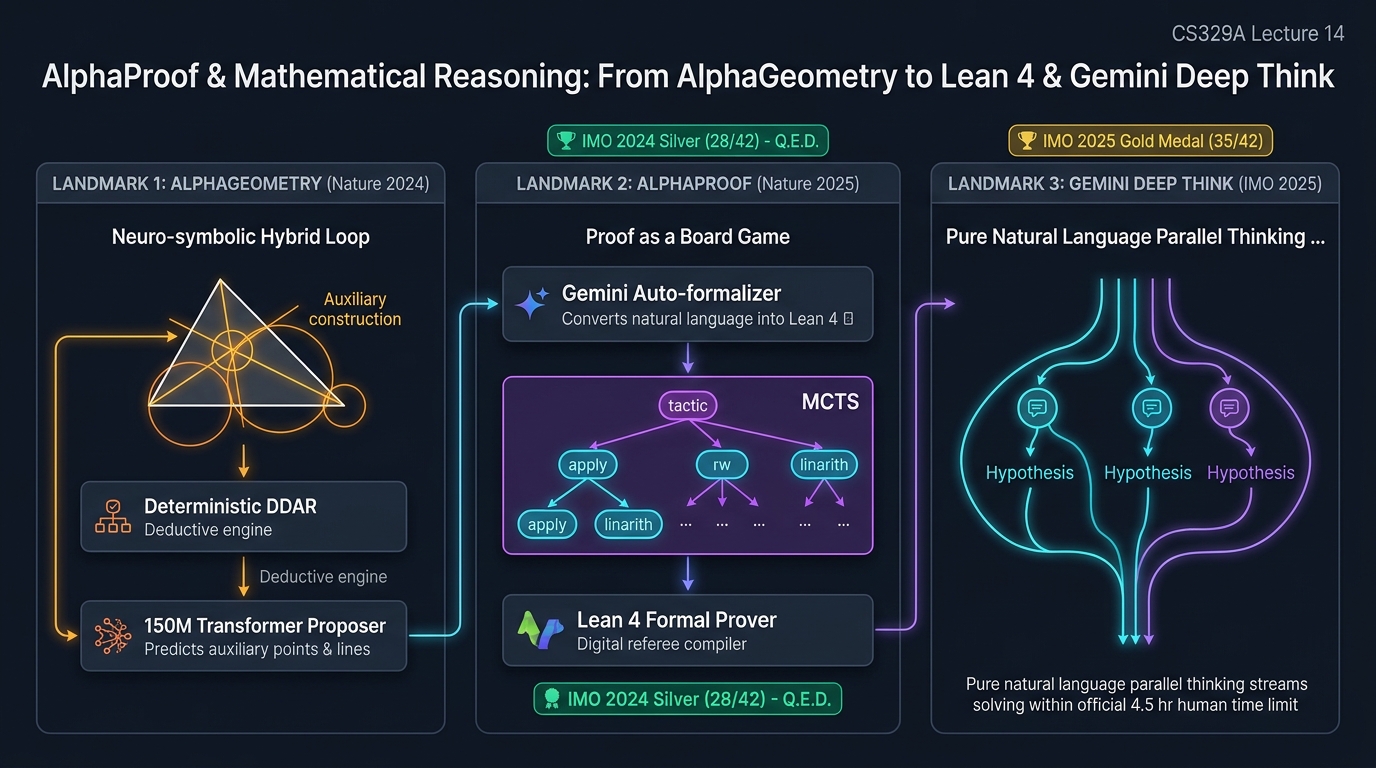
Welcome to Lecture 14 of Stanford CS329A: Self-Improving AI Agents. Grounded in the landmark breakthroughs directed by Dr. Thang Luong (Senior Research Director at Google DeepMind), we examine how artificial intelligence transitioned from probabilistic next-token generation to mathematically infallible deduction, culminating in historic medal-winning performances at the International Mathematical Olympiad (IMO):
- AlphaGeometry (Nature 2024): The neuro-symbolic synthesis uniting deterministic deductive engines with generative transformers for auxiliary geometric constructions.
- AlphaProof (DeepMind, Nature 2025): Transforming formal theorem proving into an AlphaZero board game using Lean 4, automated formalization, and Test-Time Reinforcement Learning (TTRL).
- Gemini Deep Think (IMO 2025): The triumph of pure natural language reasoning and parallel thinking, securing an official IMO Gold Medal (35/42) within the human 4.5-hour time constraint.
- LLM Formal Verification & Mathematical Reasoning: Comparing computer-checked formal kernels against unconstrained reinforcement learning.
1. Mathematics: The Ultimate Litmus Test for Artificial Intelligence
Why is mathematics widely recognized as the supreme proving ground for artificial cognitive agents? While code benchmarks (SWE-bench) and conversational tasks allow for partial credit, heuristic workarounds, and forgiving fuzziness, formal mathematics imposes three non-negotiable structural constraints:
┌──────────────────────────────────────────────────────────────────────────┐
│             Why Mathematics is the Ultimate Acid Test for AI             │
└────────────────────────────────────┬─────────────────────────────────────┘
                                     │
        ┌────────────────────────────┼────────────────────────────┐
        ▼                            ▼                            ▼
┌─────────────────────────┐  ┌─────────────────────────┐  ┌─────────────────────────┐
│ Objective Verifiability │  │ Extreme Reward Sparsity │  │ Massive Combinatorial   │
├─────────────────────────┤  ├─────────────────────────┤  ├─────────────────────────┤
│ • Formal logic systems  │  │ • 100-step deductions   │  │ • Infinite branching    │
│   (Lean 4, Coq, Isabelle)│ │   receive 0 reward until│    factors in lemma space   │
│ • Deterministic compiler│  │   final Q.E.D. closure  │  │ • Auxiliary point/line  │
│ • 0% hallucination rate │  │ • Credit assignment is  │    inventions require true  │
│ • Binary Truth: 0 or 1  │  │   catastrophically hard │    geometric creativity     │
└─────────────────────────┘  └─────────────────────────┘  └─────────────────────────┘
- Objective Mechanical Verifiability: Unlike literary essays or legal briefs where evaluation is subjective, formal mathematics can be verified by a deterministic computer program (such as the Lean 4 type checker) with 100% mathematical certainty.
- Extreme Reward Sparsity: In an olympiad-level proof spanning hundreds of intermediate tactical inferences, a system receives zero positive reward until the terminal objective (
Goal Solved) is reached. A proof that is 99% complete but fails at the final equality receives a reward of zero. - Massive Combinatorial Search Space: Unlike chess (average branching factor $\approx 35$) or Go ($\approx 250$), the space of possible mathematical lemmas, definitions, and geometric constructions is unbounded ($b \to \infty$).
2. Neuro-Symbolic Synthesis: AlphaGeometry (Trinh et al., Nature 2024)
Euclidean geometry problems at the International Mathematical Olympiad are legendary for humbling human prodigies. Even if a contestant memorizes every textbook theorem, they cannot proceed unless they make a creative Auxiliary Construction — such as drawing an unstated circle passing through three non-obvious points, or dropping an auxiliary perpendicular line.
Historically, artificial intelligence was divided into two isolated camps:
- Symbolic Deductive Engines (DDAR): Fast, 100% logically sound, and immune to calculation errors, but utterly devoid of intuition or creativity. Once standard algebraic rules exhaust their immediate conclusions, the engine stalls permanently.
- Deep Neural Networks (Transformers): Rich in creative intuition and pattern recognition, but prone to arithmetic hallucinations, coordinate drift, and ungrounded conjectures.
AlphaGeometry achieved a breakthrough by binding these two paradigms into an asymmetric co-dependent architecture:
               +-------------------------------------------+
               |         Euclidean Geometry Problem        |
               +---------------------+---------------------+
                                     |
                                     v
                        +----------------------------+
                        |  Symbolic Reasoner (DDAR)  | <---------+
                        |  - Deductive Database (DD) |           |
                        |  - Algebraic Reasoner (AR) |           |
                        +--------------+-------------+           |
                                       |                         |
                         [Is proof goal achieved?]               |
                           /                   \                 |
                        (Yes)                  (No / Stalled)    |
                         /                       \               |
                        v                         v              |
             +--------------------+    +-----------------------+ |
             | Output Full Proof  |    | 150M Transformer      | |
             | (Human-Readable)   |    | Auxiliary Proposer    | |
             +--------------------+    +-----------+-----------+ |
                                                   |             |
                                      [Predict Auxiliary Nodes]  |
                                      (Points, Lines, Circles)   |
                                                   +-------------+
The 100M Synthetic Data Engine
The central bottleneck in training AlphaGeometry was data scarcity: across centuries of human olympiads, fewer than 1,000 formal geometry proofs existed. The DeepMind team engineered a synthetic generation pipeline:
- Random Geometric Graph Generation: The system sampled 1 billion random configurations of points, intersecting segments, and circles.
- Forward Deductive Tracing: The symbolic DDAR engine traced all deductive paths that naturally emerged across these configurations, producing over 100 million valid geometric theorems.
- Auxiliary Dependency Pruning: The pipeline isolated 9 million synthetic proofs where the final theorem was provable only if a specific auxiliary point or line had been injected into the diagram.
- Supervised Distillation: A 150M parameter Transformer was trained specifically to predict these indispensable auxiliary constructions whenever the deductive engine stalled.
Benchmark Results
On a rigorous test set of 30 historical IMO geometry problems:
- The previous state-of-the-art symbolic method (Wu's method) solved only 10 problems.
- AlphaGeometry solved 25 out of 30 problems within the official human time limit, rivaling the performance of human IMO gold medalists.
- In 2004 IMO Problem 1, AlphaGeometry discovered that a key premise asserted by the human competition committee was mathematically redundant, producing a generalized theorem unknown to the original problem authors.
3. Proof as a Board Game: AlphaProof (Nature 2025)
Geometry, however, is merely one subdiscipline of mathematics. To conquer number theory, abstract algebra, and combinatorics, an agent must manipulate formal symbolic statements across deep multi-step deduction trees.
In July 2024, Dr. Thang Luong and Google DeepMind unveiled AlphaProof, a system that reframed theorem proving into a two-player zero-sum game played against a formal kernel.
┌──────────────────────────────────────────────────────────────────────────┐
│                   AlphaProof Architecture Pipeline                       │
└────────────────────────────────────┬─────────────────────────────────────┘
                                     │
     ┌───────────────────────────────┴───────────────────────────────┐
     ▼                                                               ▼
┌──────────────────────────┐                   ┌───────────────────────────┐
│ Gemini Auto-Formalizer   │                   │ AlphaZero Search Network  │
├──────────────────────────┤                   ├───────────────────────────┤
│ • Natural Language Math  │                   │ • 3B Parameter Transformer│
│ • 100M Raw Problems      │                   │ • Lean 4 Tactic Policy:   │
│ • Bidirectional Translation                   │   apply, rw, linarith     │
│ • Lean 4 Formal Specs    │                   │ • Value Head: Distance to │
│ • 80M Valid Theorems     │                   │   Terminal Q.E.D. Goal    │
└────────────┬─────────────┘                   └─────────────┬─────────────┘
             │                                               │
             └───────────────────────┬───────────────────────┘
                                     ▼
                      ┌─────────────────────────────┐
                      │    Lean 4 Formal Kernel     │
                      ├─────────────────────────────┤
                      │ • Strict Type Checker       │
                      │ • Environment Feedback Loop │
                      │ • Binary Verification:      │
                      │   - Tactic Compile Success  │
                      │   - Type Inhabitation Q.E.D.│
                      └─────────────────────────────┘
The Lean 4 Environment: The Infinite Chessboard
Lean 4 is a purely functional programming language based on the Calculus of Inductive Constructions (CIC). Under the Curry-Howard correspondence:
- A Mathematical Proposition is a Type.
- A Mathematical Proof is a Program (Term) that inhabits that type.
- The Lean Compiler acts as an infallible referee: if the proof code compiles, the mathematical theorem is unconditionally, 100% verified.
At each step of the proof, AlphaProof's policy network observes the current Goal state and selects a formal tactic (such as induction, ring, rw [mul_comm], or linarith).
Auto-Formalization: Bridging Natural Language and Formal Logic
Fewer than 1,000 human mathematicians worldwide write Lean 4 fluently. To overcome this data barrier, DeepMind utilized Gemini to auto-formalize millions of unstructured textbook and competition problems into Lean 4 statements. By coupling this with a formal semantic back-translation verifier, DeepMind constructed a clean training library of 80 million formalized mathematical statements.
Test-Time Reinforcement Learning (TTRL)
When confronting IMO 2024 Problem 6 — an extraordinarily difficult combinatorics problem solved by only 5 out of 609 human elite contestants — AlphaProof's base policy network stalled. DeepMind deployed Test-Time Reinforcement Learning (TTRL):
[IMO Problem 6 Input]
         │
         ▼
[Gemini Automated Problem Synthesizer]
         │
         ├──> Synthesize 400,000 Structural Problem Variations
         │    (Simpler parameterizations, edge cases, sub-lemmas)
         ▼
[Cluster of Thousands of TPU v5e Chips]
         │
         ├──> Execute Distributed AlphaZero Self-Play on Variations
         ├──> Model updates synaptic weights dynamically over 3 Days
         ▼
[Specialized Expert Network Generated at Test Time]
         │
         ▼
[100% Mathematically Verified Lean 4 Proof of Problem 6 Completed!]
By dedicating massive computational power at inference time to generate and master a synthetic curriculum of 400,000 related sub-problems, AlphaProof solved Problem 6, securing 28 out of 42 points — an official IMO Silver Medal, missing the Gold threshold by a single point.
4. Pure Natural Language Reasoning: Gemini Deep Think (IMO 2025)
Despite AlphaProof's historic triumph, it suffered from two practical limitations:
- Translating natural language problems into formal Lean 4 specifications required substantial automated and manual filtering.
- The Test-Time Reinforcement Learning loop required 2 to 3 continuous days of TPU cluster compute, far exceeding the strict human competition window of 4.5 hours per day.
In July 2025, DeepMind introduced Gemini Deep Think, proving that pure natural language reasoning could achieve elite competitive supremacy without intermediate compilation to formal code:
┌──────────────────────────────────────────────────────────────────────────┐
│                   Gemini Deep Think: Parallel Thinking                   │
└────────────────────────────────────┬─────────────────────────────────────┘
                                     │
        ┌────────────────────────────┼────────────────────────────┐
        ▼                            ▼                            ▼
┌─────────────────────────┐  ┌─────────────────────────┐  ┌─────────────────────────┐
│ Hypothesis Branch A     │  │ Hypothesis Branch B     │  │ Hypothesis Branch C     │
├─────────────────────────┤  ├─────────────────────────┤  ├─────────────────────────┤
│ • Algebraic substitution│  │ • Geometric inversion   │  │ • Combinatorial bounds  │
│ • Progress: 4 steps     │  │ • Stalled at Lemma 3    │  │ • Yields asymptotic bound│
│ • Evaluates contradiction│ │ • Branch pruned cleanly │  │ • Integrated into Sol A │
└─────────────────────────┘  └─────────────────────────┘  └─────────────────────────┘
Rather than following a single sequential token chain, Gemini Deep Think deploys Parallel Thinking:
- It concurrently explores dozens of distinct algebraic, geometric, and analytic branches.
- When an individual path encounters an analytical dead-end, the model does not fail catastrophically; it extracts partial invariants, backtracks, and cross-pollinates insights across active parallel branches.
- Operating within the official 4.5-hour time constraint, Gemini Deep Think solved 5 out of 6 problems (35 out of 42 points), winning the world's first Official IMO Gold Medal.
5. Architectural Comparison: Formal Verification vs Natural Language RL
+-----------------------+----------------------------------+----------------------------------+
| Comparison Vector     | Formal Verification (AlphaProof) | Natural Language RL (Deep Think) |
+-----------------------+----------------------------------+----------------------------------+
| Verification Engine   | Lean 4 Compiler Type-Checker     | Multi-Agent LLM + Self-Critique  |
| Hallucination Risk    | Exactly 0% (Mechanically Proved) | > 0% (Risk of subtle fallacies)  |
| Search Latency        | Hours to Days (MCTS + TTRL)      | 4.5 Hours (Real-time inference)  |
| Target Domain         | High-assurance software, math    | Open-domain science, creative AI |
| Data Infrastructure   | Mathlib, Lean 4 Environment      | Large-scale RL on diverse math   |
+-----------------------+----------------------------------+----------------------------------+
6. Key Takeaways & Engineering Insights
- Synthetic Data is the Key to Frontier Reasoning: AlphaGeometry demonstrated that when high-quality real-world data is scarce, deterministic engines can generate hundreds of millions of synthetic reasoning paths to bootstrap neural intuition.
- Formal Verification Eliminates Hallucination: In mission-critical environments where errors have catastrophic costs (cryptography, medical robotics, smart contracts), agents must ground their reasoning in deterministic formal environments like Lean 4.
- Test-Time RL Represents a New Frontier: AlphaProof proved that allocating inference-time compute to synthesize problem variations and retrain weights dynamically unlocks solutions to problems previously beyond the model's capacity.
- Natural Language Parallel Thinking Matches Human Speed: Gemini Deep Think revealed that parallel hypothesis exploration allows neural models to achieve gold-medal mathematical reasoning within strict human time boundaries.
In our next lecture, Lecture 15: Autonomous Systems & Reliability, we transition from closed mathematical environments to open-world software engineering, investigating how autonomous agents maintain safety guardrails, sandbox security, and self-healing resilience in production. Stay tuned!