Stanford CS329A (Ep 8): Search & Deep Research — Program Space Search (AlphaCode), Search-o1, and Autonomous Investigation

In software engineering and high-level scientific research, true expertise is never measured by single-shot memorization. Even the most accomplished Grandmaster software engineer does not produce a thousand-line, zero-defect concurrent system on their initial keystroke. Even the most distinguished Nobel laureate cannot formulate a groundbreaking therapeutic synthesis entirely from biological memory without consulting external literature.
Human intellectual supremacy stems from systematic exploration:
"The ability to explore millions of plausible hypotheses, aggressively prune dead ends, actively query external knowledge stores to bridge cognitive voids, and synthesize noisy observations into rigorous, verifiable insights."
In this eighth lecture of Stanford CS329A: Self-Improving AI Agents, we explore how the concept of Search scales artificial intelligence across two distinct, complementary dimensions:
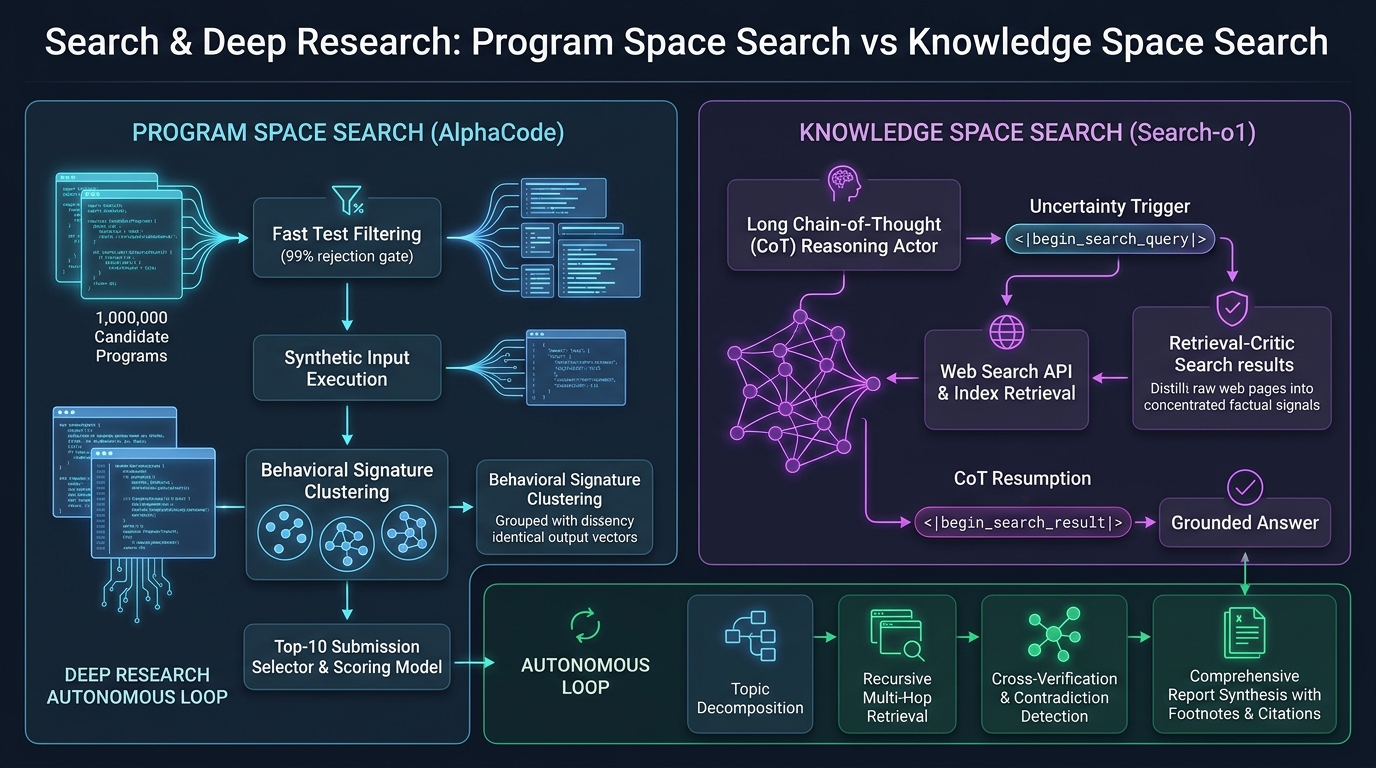
- Program Space Search: Filtering millions of candidate programs through runtime behavior signatures in AlphaCode Competitive Programming (DeepMind).
- Knowledge Space Search: Interleaving continuous reasoning with dynamic information retrieval through Search-o1 Autonomous Investigation and Self-Reflective Search Loops.
- Deep Research Agent LLM Workflows: The architecture of the modern Information Synthesis Agent, automating hypothesis decomposition, recursive web investigation, and cross-source verification.
1. The Dual Nature of Agentic Search
In classic AI, search was confined to discrete state spaces (e.g., A* graph search, minimax in chess). In modern autonomous agent architectures, search operates over continuous token probability spaces and open-ended external environments:
                          ┌─────────────────────────────────────┐
                          │     The Dual Search Frontiers       │
                          └──────────────────┬──────────────────┘
                                             │
             ┌───────────────────────────────┴───────────────────────────────┐
             ▼                                                               ▼
┌─────────────────────────────────────────┐     ┌─────────────────────────────────────────┐
│          Program Space Search           │     │          Knowledge Space Search         │
├─────────────────────────────────────────┤     ├─────────────────────────────────────────┤
│ • AlphaCode 1 & 2                       │     │ • Search-o1 & Agentic RAG               │
│ • Sparse binary rewards (Pass/Fail)     │     │ • Infinite open-world web knowledge     │
│ • 1,000,000 parallel candidate code runs│     │ • Mid-thought knowledge gap detection   │
│ • Execution Behavior Signatures         │     │ • Reason-in-Documents context filtering│
│ • Invariant output clustering           │     │ • Recursive multi-hop report synthesis  │
└─────────────────────────────────────────┘     └─────────────────────────────────────────┘
The fundamental bottleneck in both domains is the Precision-Recall Tradeoff under Compute Budgets:
- In program synthesis, sampling millions of programs achieves high theoretical coverage ($pass@k$), but official competition rules limit submissions to a handful of attempts ($10@k$).
- In open-ended research, querying the public web returns millions of tokens of unstructured HTML, advertisements, and contradictory claims that can corrupt the agent's working context window if injected indiscriminately.
2. Program Space Search: AlphaCode (DeepMind, Science 2022)
Competitive programming platforms like Codeforces represent the pinnacle of algorithmic reasoning. A problem requires reading complex natural language specifications, deriving mathematical invariants, choosing optimal data structures, and generating code that satisfies strict time ($O(N \log N)$) and memory ($256\text 256 MB$) bounds under adversarial hidden test suites.
Google DeepMind's AlphaCode conquered this problem by demonstrating that massive inference compute coupled with semantic clustering could elevate an AI system into the top 54% of human competitive programmers.
                  [Natural Language Problem Specification]
                                     │
                                     ▼
           1. Massive Diverse Sampling (1,000,000 C++/Python Programs)
              (Randomized tags: DP, Greedy, Graph; Temperature: 0.25)
                                     │
                                     ▼
           2. Sample Test Filtering (Execute on Example I/O Cases)
              (Prunes >99% of syntactically broken or trivial candidates)
                                     │
                                     ▼
           3. Synthetic Input Generation & Behavior Signature Clustering
              (Generate 10 random inputs; cluster by output vector)
                                     │
                                     ▼
           4. Top-10 Cluster Representative Selection
              (Extract 1 representative candidate from top 10 clusters)
                                     │
                                     ▼
                  [Submit 10 Solutions to Official Contest]
                  (Ranked in top 54.3% of 5,000+ Human Participants)
The Genius of Behavior Signature Clustering
Given 5,000 candidate programs that pass the basic example tests, how do we select the 10 most likely to pass the thousands of unseen hidden test cases?
Syntactic similarity metrics (e.g., BLEU, CodeBERT embeddings) fail catastrophically:
- Two programs with 99% identical code may differ by a single comparison operator (
<vs<=), turning an optimal solution into an infinite loop. - Two completely dissimilar programs (an iterative while-loop vs a recursive divide-and-conquer implementation) may execute the exact same mathematical logic.
AlphaCode solved this via Behavior Signatures:
- An auxiliary model synthesizes 10 valid random inputs for the problem.
- All 5,000 surviving programs execute these 10 inputs in a secure sandbox.
- Each program receives an execution signature vector representing its outputs:
Signature(P_i) = [ P_i(input_1), P_i(input_2), ..., P_i(input_10) ]
- The Core Invariant: Because there are exponentially many ways to write buggy code but only one consistent mathematical solution, correct programs converge onto the same output vector, forming the single largest cluster.
- AlphaCode picks one representative program from each of the 10 largest clusters for official submission.
AlphaCode 2: 10,000x Sample Efficiency via Gemini
In late 2023, DeepMind unveiled AlphaCode 2, powered by Gemini Pro:
- Replaced naive random sampling from clusters with a specialized Scoring Model trained on Codeforces execution traces.
- Achieved 85th percentile (Candidate Master level) on Codeforces.
- Shocking Finding: AlphaCode 2 matched the performance of AlphaCode 1 using only 100 samples instead of 1,000,000 — an unprecedented 10,000x improvement in sample efficiency, proving that stronger base reasoning models dramatically compress the required search volume.
3. Knowledge Space Search: Search-o1 (2025)
Moving from program code to natural language, how do long-chain reasoning models (such as OpenAI o1 or DeepSeek-R1) interact with external information?
An empirical analysis of long Chain-of-Thought (Long CoT) traces reveals that models express uncertainty keywords (e.g., "perhaps", "wait", "let me verify", "likely") on average 30.4 times per complex scientific query. In traditional RAG (Retrieval-Augmented Generation), search occurs only once at prompt initiation, failing when intermediate reasoning steps hit unforeseen knowledge voids.
Search-o1 established the paradigm of Dynamic Self-Reflective Retrieval:
sequenceDiagram
    autonumber
    participant LLM as Reasoning-Actor (QwQ-32B)
    participant Engine as Search Controller
    participant Web as Web Search API
    participant Critic as Retrieval-Critic (Reason-in-Docs)

    LLM->>LLM: Generating Long CoT Reasoning Trace...
    Note over LLM: Uncertainty Detected: "What is the binding domain sequence of CXCR4?"
    LLM->>Engine: Emits <|begin_search_query|> human CXCR4 sequence <|end_search_query|>
    Note over LLM: Reasoning Paused (State Cached in KV Cache)
    Engine->>Web: Querying Google / Bing API
    Web-->>Engine: Returns 10 Raw HTML Documents (50,000 tokens)
    Engine->>Critic: Forward Raw HTML + Current Reasoning Step
    Critic->>Critic: Filter Ads, Boilerplate, Extract Core 2-Line Fact
    Critic-->>Engine: "CXCR4 is a 352-amino acid GPCR; residue 28 binds ligand."
    Engine->>LLM: Injects <|begin_search_result|> Fact Snippet <|end_search_result|>
    Note over LLM: Reasoning Resumed
    LLM->>LLM: Completes biochemical deduction with verified factual anchor
The Two Pillars of Search-o1
- Reasoning-Actor (Self-Triggered Queries): The model autonomously interrupts its own generation when its parametric confidence drops below a threshold, emitting explicit search tags (
<|begin_search_query|>) and caching its internal key-value (KV) attention states. - Retrieval-Critic ("Reason-in-Documents"): Dumping 50,000 tokens of raw webpage text directly into an ongoing reasoning chain degrades attention precision (Context Distraction). A lightweight secondary Critic model isolates only the verified factual assertion required for the immediate reasoning step before context resumption.
Performance on GPQA Diamond (PhD-Level Scientific Reasoning):
========================================================================================
Architecture                 Overall Accuracy   Chemistry       Biology         Physics
----------------------------------------------------------------------------------------
Human Domain Experts (PhDs)     65.4%             48.9%          37.2%           39.9%
Base Reasoning Model (QwQ-32B)   58.1%             45.2%          41.5%           43.2%
Standard Static RAG Agent        61.6%             51.0%          44.8%           47.0%
Search-o1 (Dynamic CoT Search)   63.6% (+5.5p)     56.4% (+7.5p)  50.2% (+13.0p)  52.8% (+12.9p)
========================================================================================
On GPQA Diamond, Search-o1 surpassed both static RAG baselines and outscored human subject-matter PhDs across chemistry, biology, and physics benchmarks.
4. The Deep Research Agent Pipeline
By synthesizing the parallel pruning of AlphaCode with the active retrieval loops of Search-o1, we arrive at the architecture of modern Deep Research Agent LLMs (e.g., OpenAI Deep Research, Gemini Deep Research):
                       [Complex User Research Mandate]
                                      │
                                      ▼
                   ┌──────────────────────────────────────┐
                   │    Hierarchical Plan Decomposition   │
                   │ (Breaks query into 5-8 sub-questions)│
                   └──────────────────┬───────────────────┘
                                      │
          ┌───────────────────────────┼───────────────────────────┐
          ▼                           ▼                           ▼
┌──────────────────┐        ┌──────────────────┐        ┌──────────────────┐
│ Sub-Hypothesis A │        │ Sub-Hypothesis B │        │ Sub-Hypothesis C │
│ Multi-Hop Search │        │ Multi-Hop Search │        │ Multi-Hop Search │
└─────────┬────────┘        └─────────┬────────┘        └─────────┬────────┘
          │                           │                           │
          └───────────────────────────┼───────────────────────────┘
                                      │
                                      ▼
                   ┌──────────────────────────────────────┐
                   │     Cross-Source Contradiction Critic│
                   │ (Detects conflicting data & biases)  │
                   └──────────────────┬───────────────────┘
                                      │
                                      ▼
                   ┌──────────────────────────────────────┐
                   │   Evidence-Grounded Long-Form Report │
                   │(15-page synthesis with live citations│
                   └──────────────────────────────────────┘
Key Stages of Autonomous Deep Research
- Hypothesis Decomposition: Translates broad prompts (e.g., "Analyze solid-state battery manufacturing bottlenecks across Toyota and QuantumScape patents") into orthogonal technical sub-inquiries.
- Recursive Multi-Hop Traversal: Navigates links within initial technical documents to locate primary regulatory filings, whitepapers, and patent citations.
- Contradiction Resolution: Detects inconsistencies between promotional corporate press releases and independent laboratory benchmarks, explicitly tagging confidence levels.
- Traceable Attribution: Attaches immutable URL footnotes to every empirical claim, eliminating generative hallucination.
5. Architectural Comparison: Search Paradigms
=========================================================================================================
Dimension             Static RAG (Single-Hop)        AlphaCode (Program Search) Search-o1 (CoT Search)
---------------------------------------------------------------------------------------------------------
Search Space          Fixed Document Vector Store    Code Sequence Space        Public Open Web & APIs
Trigger Mechanism     Prompt Initiation Only         Sampling Phase (Inference) Self-Reflective Uncertainty
Pruning Criterion     Top-K Cosine Similarity        Behavior Signatures        Reason-in-Documents Filter
Verification Anchor   Semantic Embedding Distance    Execution Sandbox Output   Formal Logic & Cross-Source
Primary Weakness      Context Drift on Multi-Step    Extreme Compute Overhead   Web Latency in CoT Loop
=========================================================================================================
6. Deep Technical Q&A
Q1: Why is execution behavior clustering fundamentally superior to AST or embedding clustering in AlphaCode?
Code semantics cannot be inferred reliably from surface tokens. Two programs that appear 99% identical in their Abstract Syntax Tree (AST) might produce entirely different outputs due to an off-by-one array index error. Conversely, two implementations with entirely divergent ASTs (e.g., an iterative bitmask algorithm versus a recursive dynamic programming tree) may be mathematically isomorphic.
By executing programs against synthetic test inputs and grouping them by their output vectors, the system clusters by actual computational behavior. This guarantees that correct implementations group into the dominant cluster regardless of syntactic idiosyncrasies.
Q2: How does "Reason-in-Documents" solve the Context Pollution problem in long-horizon reasoning?
Large web documents contain massive amounts of irrelevant boilerplate (navigation menus, cookie disclaimers, advertisements, tangential historical context). If 20 raw web documents (approximately 40,000 tokens) are directly appended into an ongoing Chain-of-Thought, the model's self-attention distribution becomes diffuse over irrelevant tokens.
The "Reason-in-Documents" pattern uses a dedicated extraction agent to read raw documents, extract the precise 2-to-3 sentence factual resolution answering the immediate query, and inject only this purified semantic distillation back into the primary reasoning context.
Summary & What's Next
Search transforms language models from static, insular predictors into dynamic, verified problem solvers. Through AlphaCode, we witnessed how program space exploration and behavior signatures crack Grandmaster-level competitive coding. Through Search-o1 and Deep Research, we observed how real-time knowledge retrieval empowers autonomous agents to conquer doctoral-level scientific challenges.
In Lecture 9, we conclude Part 2 (Training & Evolution) with a macroscopic retrospective: Post-Training Evolution — From Next-Token Chatbots to Autonomous Agentic Fleets (SFT, RLHF, Tool Grounding, and Systemic Alignment).
Key Takeaways
- Compute-Optimal Search Scales Performance: Large sample budgets combined with rigorous pruning filters (AlphaCode) consistently outshine unguided monolithic generation.
- Behavior Over Syntax: Program clusters must be formed by runtime execution signatures, not text or AST similarity.
- Dynamic Reasoning Retrieval: Injecting refined factual knowledge during ongoing reasoning chains (Search-o1) resolves the critical factual hallucination bottleneck in complex inference.