[Stanford CS146S #10] The Future of Software Engineering: Autonomous Agent Swarms, Zero-Human Deployment Pipelines, and Managing AI Fleets at Scale
· 11 min read

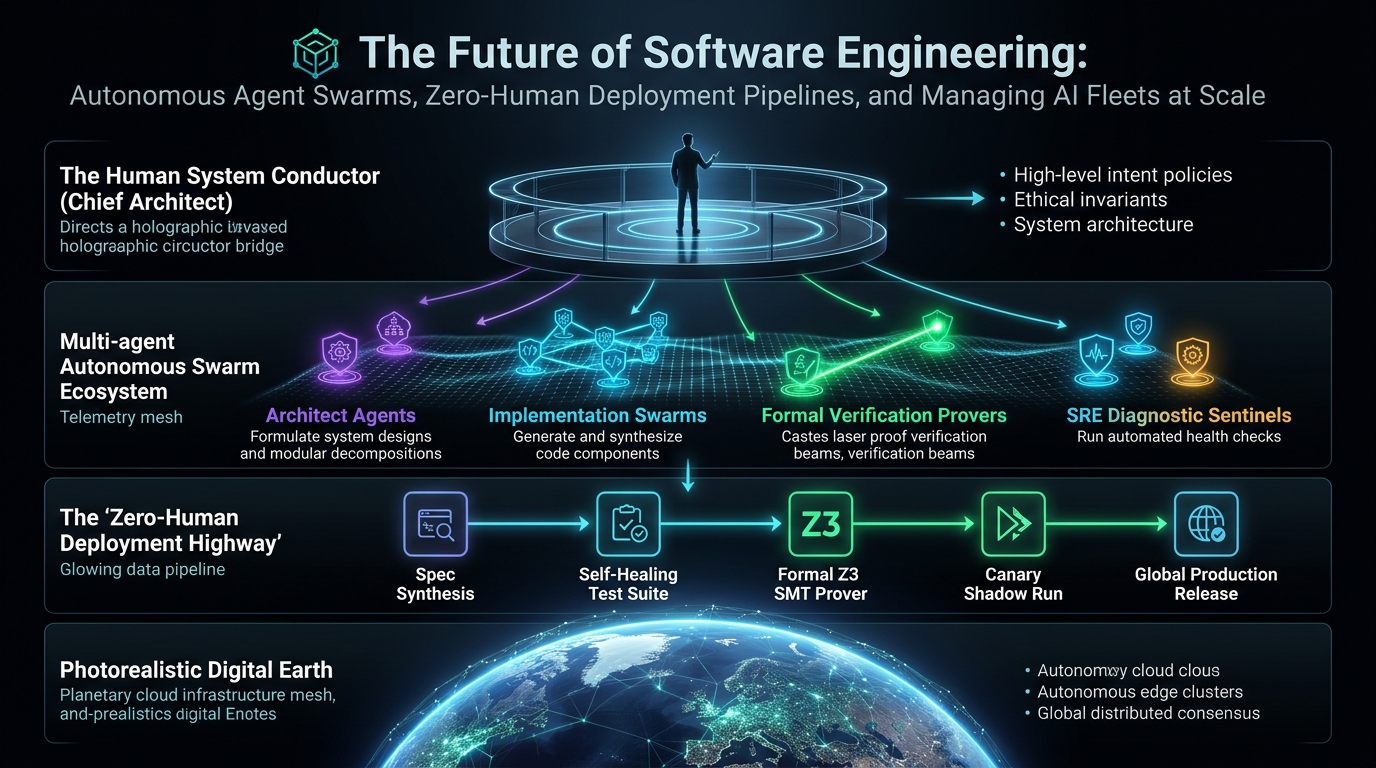
Welcome to the tenth and final installment of our comprehensive engineering series analyzing Stanford University's CS146S: The Modern Software Developer.
Over the preceding nine lectures, we dismantled the traditional paradigm of software development piece by piece:
- Lecture 1: The transition from syntax typist to system conductor.
- Lecture 2: Probabilistic token mechanics and prompt engineering.
- Lecture 3: Standardized tool execution via the Model Context Protocol (MCP).
- Lecture 4: Spec-Driven Development (SDD) and self-healing test loops.
- Lecture 5: Multi-agent swarms using the Architect-Implementer-Critic pattern.
- Lecture 6: Runtime dynamic tracing and incident mitigation with eBPF.
- Lecture 7: AST-aware linters and security taint analysis in CI/CD.
- Lecture 8: AI-native modularity, context budgets, and monolith decoupling.
- Lecture 9: Property-based invariants and mathematical proofs with Z3 SMT solvers.
In this Capstone Finale, the Stanford curriculum synthesizes these modular disciplines into a singular, unified vision: The Autonomous Software Factory. We explore how modern high-velocity organizations govern fleets of hundreds of concurrent AI agents, engineer zero-human continuous deployment pipelines, and define the enduring, indispensable role of the human engineer in an age of automated intelligence.