[Stanford CS146S #8] AI-Native Software Architecture & Refactoring: Decoupling Monoliths, Managing Semantic Debt, and Autonomous Large-Scale Migrations

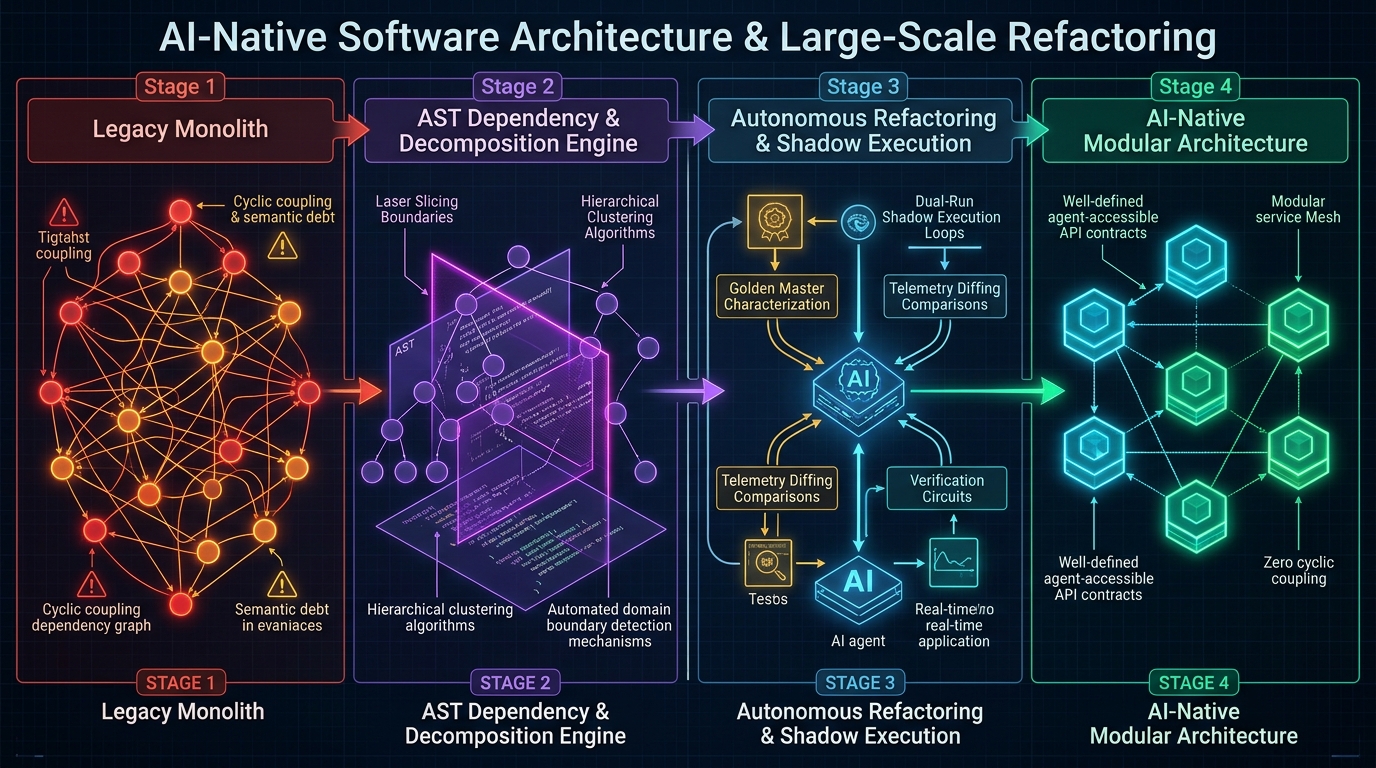
Welcome to the eighth installment of our comprehensive engineering series analyzing Stanford University's CS146S: The Modern Software Developer.
In the prior sessions, we evaluated how individual developers prompt coding LLMs (Lecture 2), integrate external tools via the Model Context Protocol (Lecture 3), engineer self-healing test harnesses (Lecture 4), coordinate multi-agent swarms (Lecture 5), profile runtime anomalies with eBPF (Lecture 6), and automate PR code reviews using AST linters and taint analysis (Lecture 7).
In Lecture 8, the curriculum confronts the systemic, long-term consequence of deploying high-velocity AI agents into production repositories: How do we design software architectures that AI agents can navigate, reason about, and modify without collapsing under the weight of runaway complexity? And how do we employ AI agents to safely refactor and decouple legacy monolithic codebases?
As engineering teams scale AI agent adoption, they quickly discover that traditional software architectures—characterized by massive shared mutable states, implicit cyclic dependencies, and sprawling 100,000-line monoliths—severely bottleneck LLM reasoning. In this lecture, Stanford computer scientists formalize the concept of Semantic Debt, define the foundational tenets of AI-Native Architecture, and provide a battle-tested blueprint for AST-guided automated monolith decoupling.