[Stanford CS329A #1] Course Overview: From Large Language Models to Self-Improving AI Agents

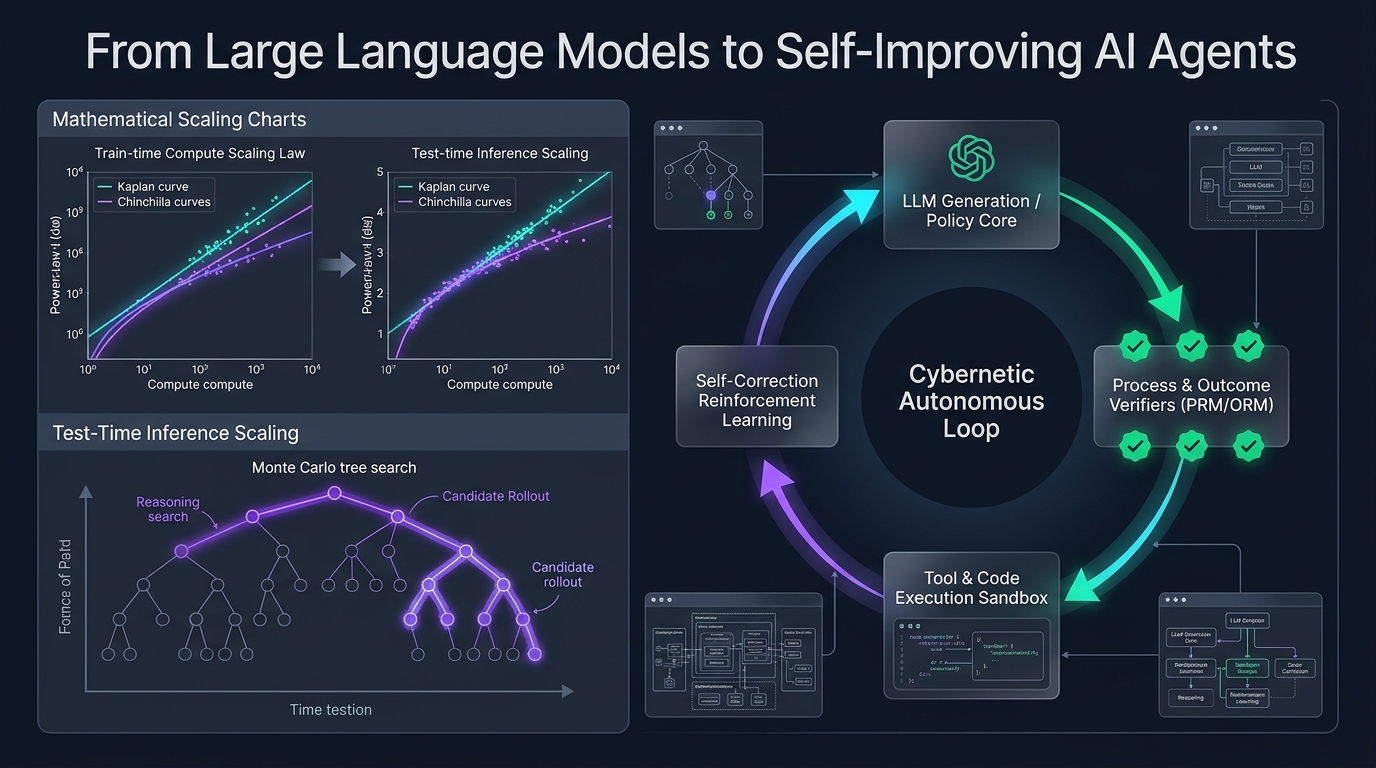
Welcome to the definitive technical breakdown of Stanford University's CS329A: Self-Improving AI Agents (Autumn 2025).
Over the past four years, the artificial intelligence landscape has been dominated by a single, powerful dogma: pre-training larger models on larger text corpora yields ever-increasing cognitive capabilities. While this paradigm sparked the modern generative AI revolution—giving rise to GPT-4, Claude 3.5, and Gemini—the frontier of machine learning research has hit a pivotal inflection point.
Static foundation models, however immense their parameter counts, remain fundamentally bounded: they are passive, autoregressive next-token predictors operating in an open-loop regime. Once their weights are frozen post-training, they cannot dynamically allocate compute to harder problems, cannot autonomously verify the factual correctness of their solutions, and cannot iteratively self-correct their errors based on environmental feedback.
flowchart LR
    subgraph Static_Era ["The Static Paradigm (2020-2024)"]
        direction TB
        A1[Massive Web Corpus] --> B1[Pre-Training Cluster]
        B1 --> C1[Supervised Fine-Tuning]
        C1 --> D1[Static Frozen Model]
        D1 -->|Single Forward Pass| E1[One-Shot Text Response]
    end

    subgraph Autonomous_Era ["Stanford CS329A Frontier: Self-Improving Agents"]
        direction TB
        A2[Complex Task Goal] ==> B2[Reasoning & Planning Engine]
        B2 -->|Draft Actions / Code| C2[Sandbox Environment & Tools]
        C2 -->|Execution Trace & State| D2[Process Verifiers & PRMs]
        D2 -->|Reward & Error Signal| B2
        D2 ==>|Test-Time & Train-Time Update| E2[Continuous Self-Evolution]
    end
Stanford CS329A addresses the central question of the next decade of AI: How do we build software agents that do not merely generate text, but continuously inspect, verify, plan, and improve their own reasoning and code?
In this inaugural overview lecture, we deconstruct the evolutionary trajectory from foundational LLMs to agentic systems, formalize the mathematics of scaling laws and inference-time compute allocation, analyze the four canonical agent workflow archetypes, and isolate the critical bottleneck of autonomous intelligence: the Generator-Verifier Gap.