[Stanford CS146S #7] Automated Code Review at Scale: AST-Aware Linters, Security Taint Analysis, and Autonomous LLM PR Reviewers

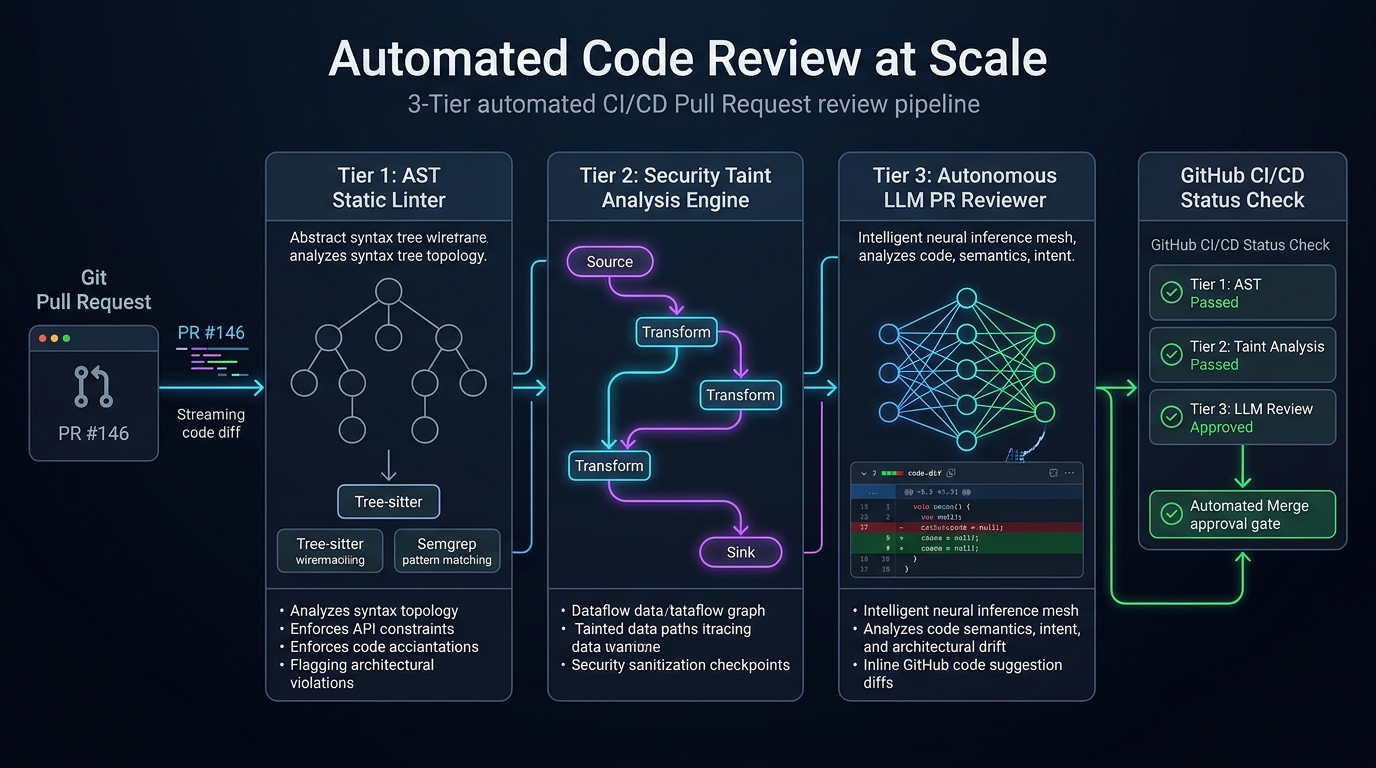
Welcome to Lecture 7 of our deep-dive series covering Stanford University’s CS146S: The Modern Software Developer.
In our previous lecture, we tackled runtime production incidents using eBPF non-intrusive kernel tracing and AI SRE diagnostic hotpatching. Yet, as every seasoned engineering leader knows, the most cost-effective bug is the one that never merges into the mainline branch in the first place.
In high-velocity software engineering organizations, the Pull Request (PR) code review is the primary gatekeeper of software quality, architectural integrity, and security. However, as engineering teams scale, human code review inevitably degenerates into a massive operational bottleneck. Senior engineers spend 15 to 20 hours a week reviewing diffs, burning cognitive bandwidth on trivial stylistic nitpicks (indentation, naming conventions, import ordering) while suffering from review fatigue on massive 1,000-line changes—inevitably waving through insidious concurrency races, SQL injections, and architectural boundary violations.
In today’s lecture, Stanford faculty unveil the blueprint for Automated Code Review at Scale. By constructing a three-tier review hierarchy that couples Abstract Syntax Tree (AST) linters, Inter-procedural Security Taint Analysis, and Autonomous LLM PR Reviewers, modern engineering teams can eliminate 90% of manual code review toil while drastically increasing vulnerability detection rates.