[Stanford CS329A #3] Robust Verification: Process Reward Models (PRM), Ensembles, and Scalable Oversight

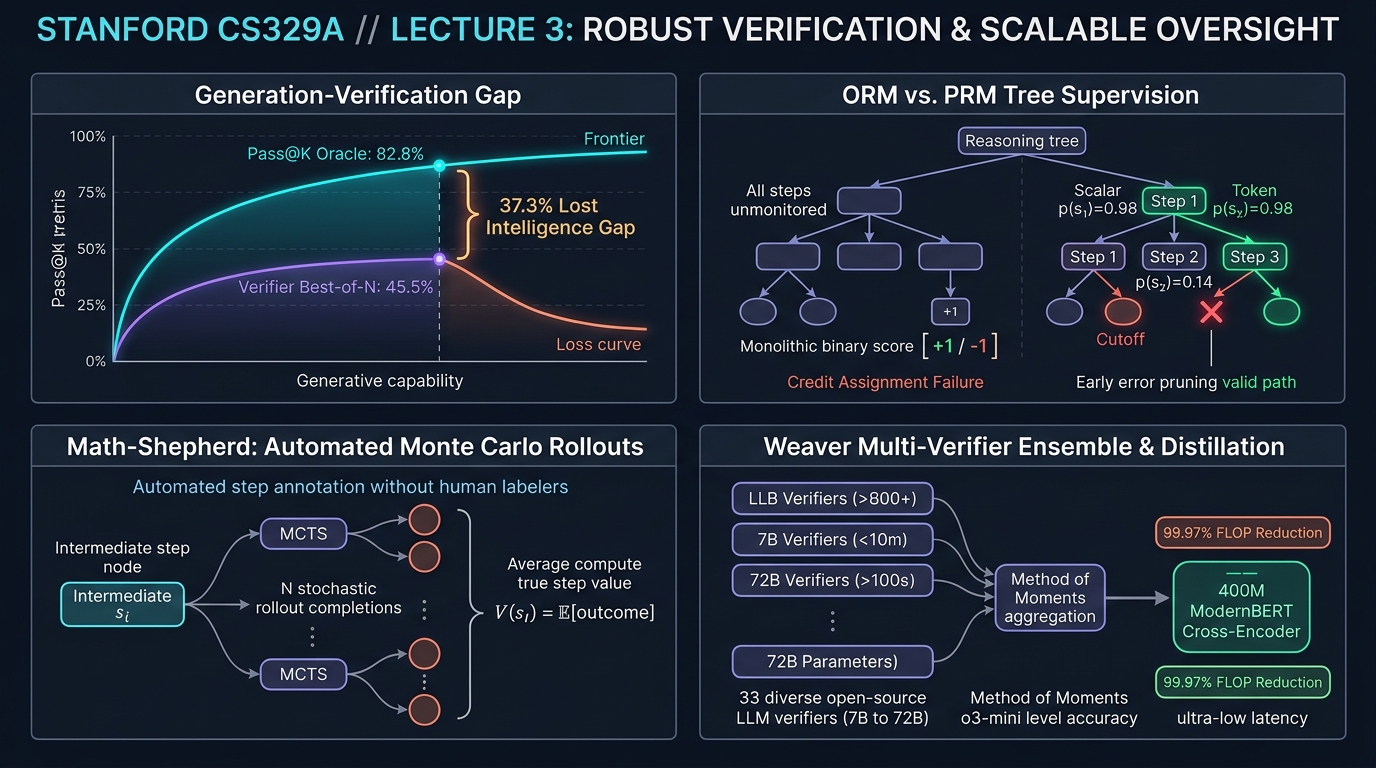
Welcome to the third installment of our definitive engineering breakdown of Stanford University's CS329A: Self-Improving AI Agents (Autumn 2025).
In Lecture 2, we examined the mechanics of test-time compute scaling and reached a sobering conclusion: while generating thousands of candidate trajectories ($pass@k$) pushes theoretical solution coverage above 99%, this raw potential remains fundamentally unusable without a high-precision verifier. When evaluated with crude heuristics like majority voting, model accuracy hits an insurmountable plateau.
Today, we confront the core architectural engine that breaks through this bottleneck: Robust Verification.
Human mathematicians and software engineers rarely solve complex problems in an unthinking, single-shot stream of consciousness; they write down a step, verify its algebraic consistency, catch subtle arithmetic slips, and backtrack before committing to subsequent derivations. Conversely, standard autoregressive language models operate strictly forward in time. Once an early token wanders off course, the model hallucinates increasingly convoluted rationalizations to justify its initial error.
How do we design independent verifier models capable of inspecting intermediate reasoning steps, diagnosing logical fallacies, and guiding autonomous agents to ground-truth solutions without requiring millions of dollars in human annotation?
Through the foundational research of Cobbe et al. (GSM8K, OpenAI, 2021), Lightman et al. (PRM800K, 2023), automated Monte Carlo step annotation (Math-Shepherd, Yu et al., 2023), and the state-of-the-art Weaver ensemble framework (NeurIPS 2025), we will dismantle and rebuild the state of the art in Verifier Engineering.
flowchart TD
    subgraph Gap ["The Core Problem: The Generation-Verification Gap"]
        direction TB
        G1["Pass@100 Oracle Coverage: 82.8% (Upper Bound)"]
        G2["Majority Vote Accuracy: 45.5% (Actual Output)"]
        G1 -.->|"37.3% Lost Cognitive Potential"| G2
    end

    subgraph Solutions ["The Verification Evolution"]
        direction TB
        S1["Outcome Reward Models (ORM)<br/>• Binary reward on final answer (+1 / -1)<br/>• Severe Credit Assignment Failure"]
        --> S2["Process Reward Models (PRM800K)<br/>• Token-level Step Supervision p(step_i)<br/>• Early branch pruning & product scoring"]
        --> S3["Math-Shepherd (Unsupervised MCTS)<br/>• Automated Monte Carlo step rollouts<br/>• Outperforms human-annotated PRMs"]
        --> S4["Weaver Multi-Verifier Ensemble<br/>• Method of Moments aggregation (33 weak verifiers)<br/>• Distilled into 400M Cross-Encoder (99.97% FLOPs cut)"]
    end

    Gap ==> Solutions