[Stanford CS146S #6] AI-Assisted Debugging & Runtime Profiling: Leveraging eBPF, Dynamic Tracing, and LLMs for Incident Mitigation

Welcome to Lecture 6 of our deep-dive series covering Stanford University’s CS146S: The Modern Software Developer.
In our preceding lecture, we explored multi-agent swarm orchestration—coordinating Architect, Implementer, and Critic LLMs through structured DAG workflows to write massive modular codebases. Yet, even the most rigorously tested software eventually encounters the chaotic crucible of production.
At 3:00 AM, when an obscure concurrency deadlock freezes a distributed payment cluster or an unindexed database query causes tail latency to spike to 12 seconds, traditional developer debugging workflows collapse. Static analysis cannot predict dynamic race conditions, invasive printf debugging introduces the Heisenbug effect (altering timing and masking the bug), and distributed APM tracing tools drown Site Reliability Engineers (SREs) in gigabytes of unstructured log noise.
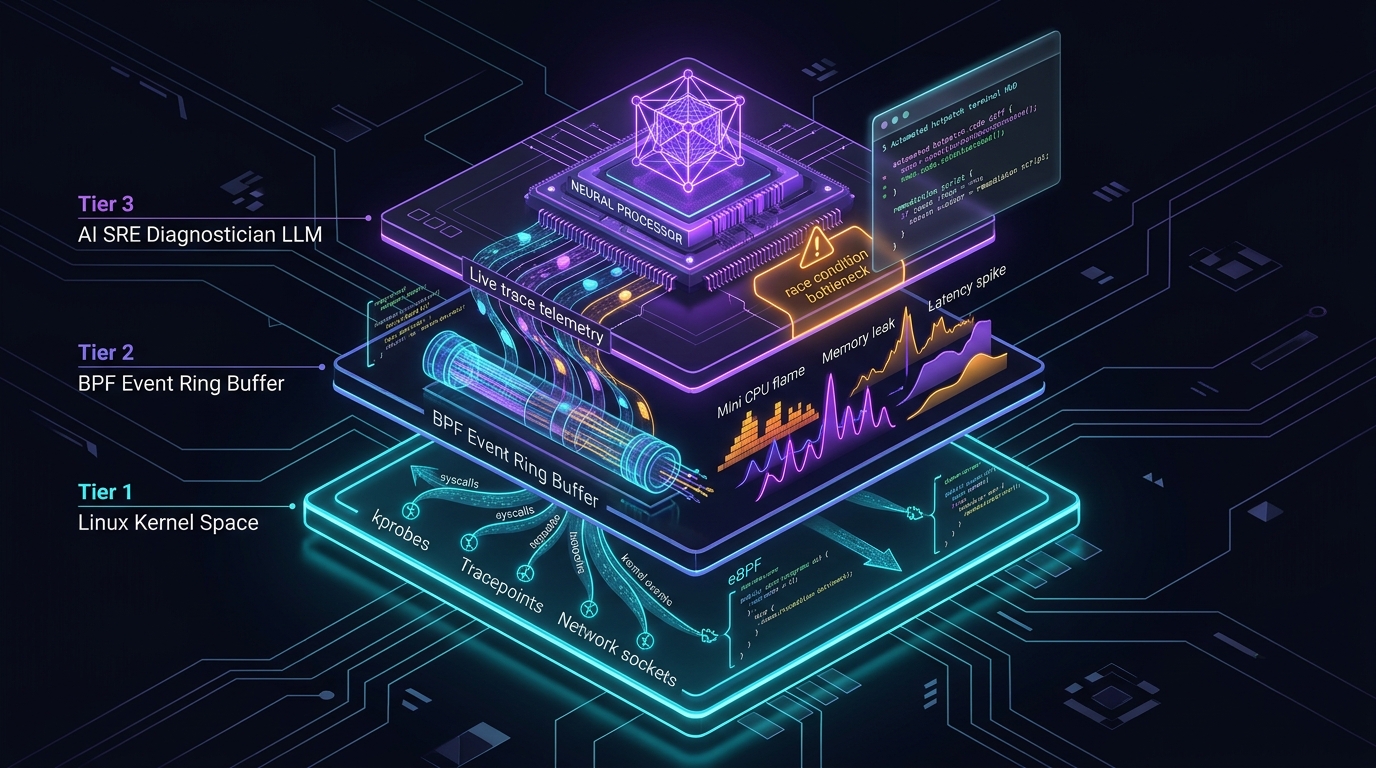
In today's lecture, Stanford faculty unveil the next frontier in autonomous software resilience: AI-Assisted Debugging & Runtime Profiling. By combining the zero-overhead, non-intrusive power of extended Berkeley Packet Filters (eBPF) with specialized LLM Diagnostic SRE Agents, modern engineering teams can capture kernel-level execution states in real-time, perform automated root-cause identification, and synthesize hotfixes in minutes rather than hours.