[Stanford CS146S #5] Multi-Agent Systems & Swarm Orchestration: Coordinating Autonomous Architect, Implementer, and Critic LLMs

Welcome to Lecture 5 of our deep-dive series covering Stanford University’s CS146S: The Modern Software Developer.
In our previous lectures, we mastered developer prompt engineering, dissected the internal transformer mechanics of coding models, explored tool-use with the Model Context Protocol (MCP), and constructed self-healing spec-driven test harnesses. Each of these paradigms operated under a common implicit assumption: a single primary LLM session interacting with a single developer or IDE workspace.
However, once a software project scales beyond a few thousand lines of code across distributed microservices, the single-agent paradigm fractures. Monolithic agents suffer from context window saturation, attention dilution, and cognitive thrashing.
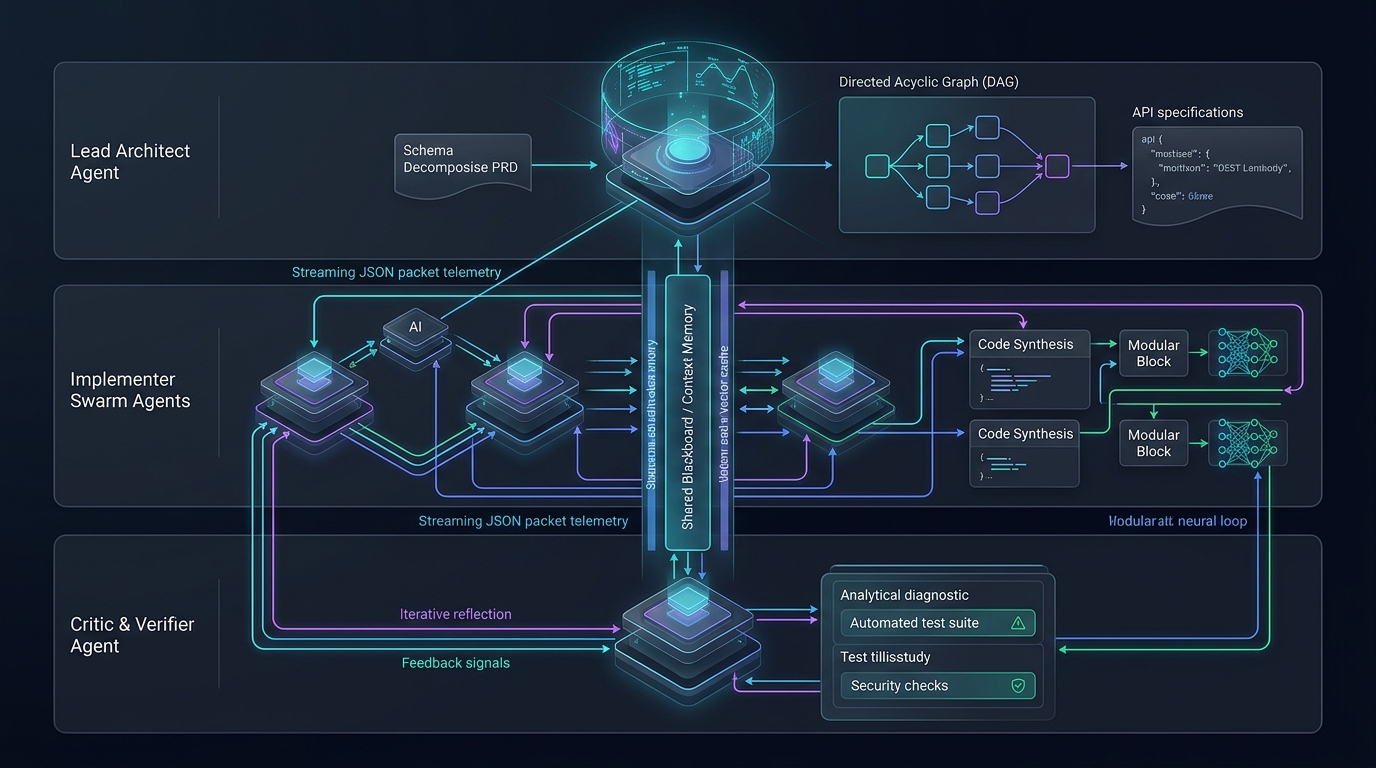
In today’s lecture, Stanford faculty unveil the future of AI-native engineering: Multi-Agent Systems (MAS) and Swarm Orchestration. We will explore how separating concerns across specialized Architect, Implementer, and Critic roles—coordinated over structured message buses and Directed Acyclic Graphs (DAGs)—delivers order-of-magnitude gains in software generation accuracy and codebase scale.