[Stanford CS146S #9] Autonomous TDD & Formal Verification: Z3 SMT Solvers, Property-Based Invariants, and Mathematical Proofs for AI-Generated Code

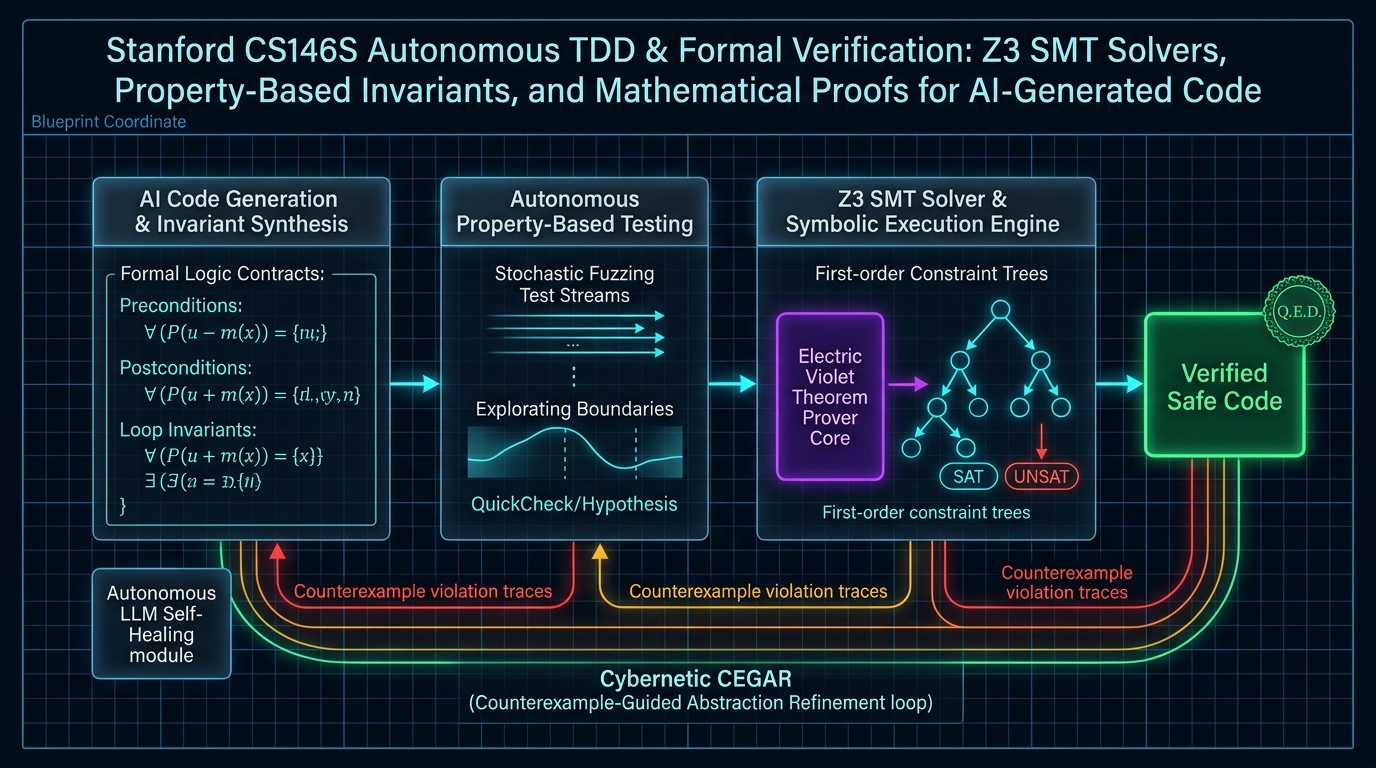
Welcome to the ninth installment of our engineering analysis series on Stanford University's CS146S: The Modern Software Developer.
Throughout this curriculum, we have evaluated prompt engineering mechanics (Lecture 2), tool integrations via the Model Context Protocol (Lecture 3), self-healing CI regression loops (Lecture 4), multi-agent swarms (Lecture 5), runtime tracing with eBPF (Lecture 6), AST-guided code reviews (Lecture 7), and AI-native modular architecture (Lecture 8).
In Lecture 9, the Stanford curriculum confronts the ultimate dilemma of modern AI engineering: How can software teams trust non-deterministic, probabilistic foundation models to write mission-critical, zero-defect code in finance, aerospace, cryptography, and distributed systems?
As Edsger Dijkstra famously observed over fifty years ago: "Program testing can be used to show the presence of bugs, but never to show their absence!" In this lecture, Stanford computer scientists outline the transition from empirical unit testing to Autonomous Property-Based Testing (PBT), Symbolic Execution, and Formal Verification using the Z3 SMT (Satisfiability Modulo Theories) solver.