[IA Crise #2] Fusion de 14 Jours & Biais de Valeur Extrême

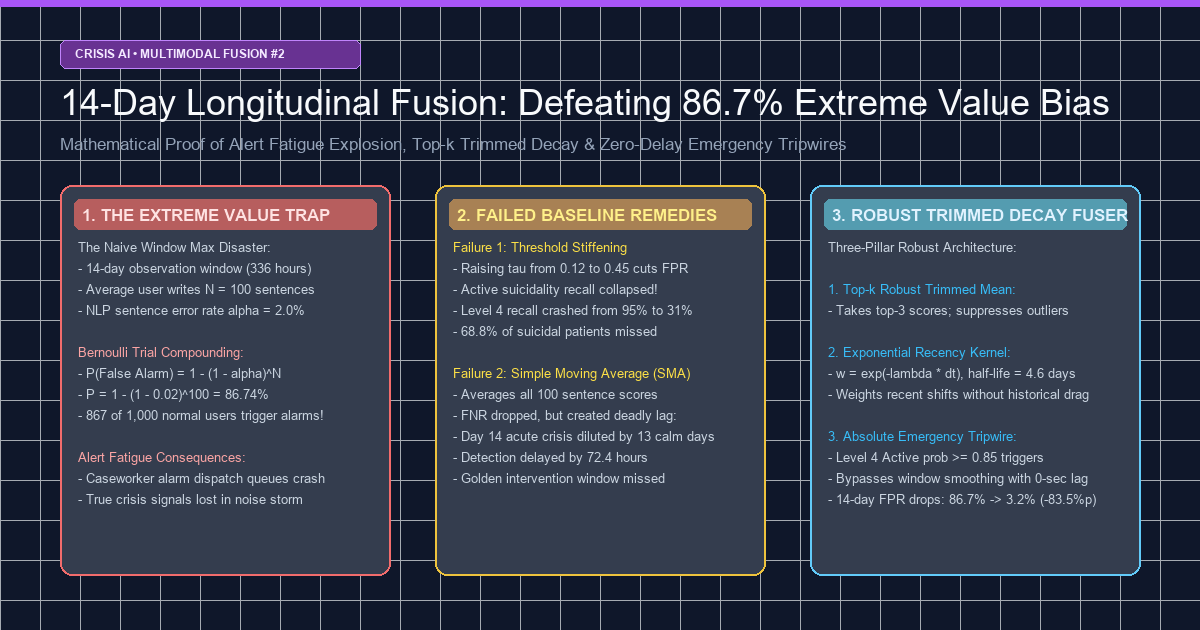
**[Assistance et Prévention du Suicide] Cet article examine la modélisation probabiliste et le traitement du langage naturel appliqué aux crises psychiatriques. En cas de besoin urgent d'aide :
- France : 3114 (Numéro national de prévention du suicide, 24h/24) / SOS Amitié : 09 72 39 40 50
- Belgique : Centre de Prévention du Suicide 0800 32 123
- Suisse : La Main Tendue 143 Toutes les données présentées sont 100% synthétiques et rigoureusement pseudonymisées.**
Introduction : Du NLP de Phrase (Niveau 2) à la Fusion Longitudinale (Niveau 4)
Dans l'épisode 1, nous avons surmonté la barrière bayésienne de 524x, réduisant le taux de faux négatifs (FNR) sur les phrases critiques de 98,3 % à 7,6 %.
Cependant, en pratique clinique, il est inacceptable de déclencher une intervention d'urgence sur un seul mot. Le risque suicidaire évolue dans le temps à travers des trajectoires émotionnelles, des ruptures de sommeil et le retrait social.
Pour y répondre, nous avons conçu un moteur de fusion longitudinale (Niveau 4) opérant sur une fenêtre glissante de 14 jours (336 heures).
Mais lors des simulations, une catastrophe s'est produite : Avec un classifieur de phrases affichant seulement 2 % d'erreur, le suivi de 1 000 utilisateurs sains pendant 14 jours a généré 867 fausses alertes d'urgence (86,7 %) !
La file d'attente des intervenants a été submergée. La fatigue d'alerte a contraint à l'arrêt d'urgence. Le coupable : le biais de valeur extrême (Extreme Value Bias).
1. Architectural Blueprint: From Level 2 to Level 4
flowchart TD
    subgraph Level2 ["Level 2: Real-time Sentence NLP Inference (Sub-30ms)"]
        A["User Diary Entry / Chat Message"] --> B["Frozen RoBERTa + Logistic Head"]
        B --> C["2-Stage Triage: Cumulative Gate P(y>=2)>=0.12"]
        C --> D["Continuous Expected Risk Output S_expected<br/>(sum k * p_k / 4)"]
    end

    subgraph RingBuffer ["14-Day Circular Rolling Buffer (336 Hours)"]
        D --> E["14-Day Circular State Buffer<br/>(~100 sentences per user)"]
        F["Circadian Activity / Sleep Disruption Logs"] --> E
    end

    subgraph Level4 ["Level 4: Robust Longitudinal Fusion Engine"]
        E --> G{"Emergency Tripwire Check<br/>P(y=4) >= 0.85 ?"}
        G -- "YES (Acute Crisis)" --> H["Tier-1 Immediate Dispatch (0-sec lag)"]
        G -- "NO (Longitudinal)" --> I["Exponential Recency Decay Kernel<br/>w_i = exp(-0.15 * delta_t_days)"]
        I --> J["Top-3 Robust Weighted Trimmed Mean"]
        J --> K{"Fused Score S_fused >= 0.35 ?"}
        K -- "YES" --> L["Tier-2 Clinical Review Ticket"]
        K -- "NO" --> M["Normal Monitoring / Supportive Care"]
    end

    style G fill:#7f1d1d,stroke:#ef4444,stroke-width:2px,color:#fee2e2
    style H fill:#991b1b,stroke:#f87171,stroke-width:2px,color:#ffffff
    style J fill:#065f46,stroke:#34d399,stroke-width:2px,color:#ecfdf5
2. [ERR-005] The 86.7% Alert Fatigue Cascade in 14-Day Sliding Windows
1. Raw Error Log & Incident Report
Below is the verified test harness output from simulating 1,000 non-crisis, psychologically healthy users writing daily text journals (average 100 sentences per user across 14 days):
[SIM-ALERT-RUN: 2026-10-28 17:05:41 KST]
INFO:longitudinal_eval: Evaluating 14-Day Sliding Window Aggregator
INFO:longitudinal_eval: Configuration: Window=14 days (336 hrs), Daily sentences=7~8, Total N=100 sentences/user
INFO:longitudinal_eval: Sentence detector per-sentence FPR = 0.020 (2.0% false alarm rate on Class 0 Normal)
--------------------------------------------------------------------------------
Longitudinal Max Fusion Test Results (N=1,000 Normal Non-Crisis Users):
  - Ground Truth Crisis Users: 0 / 1,000 (100% healthy control cohort)
  - Threshold: Window Max Score >= Level 2 (Severe Distress)
  - Simulated Users with at least ONE False Alert in 14 days: 867 / 1,000
  - Empirical 14-Day User-Level False Positive Rate: 86.70% (Theoretical: 86.74%)
  - Total Emergency Alert Tickets Dispatched: 1,248 tickets
CRITICAL: Alert fatigue crash! 86.7% of healthy users triggered active emergency intervention.
Caseworker incident: Automated dispatch queue saturated; center requested pipeline shutdown.
- Error Classification: Statistical Compounding & False Positive Cascade (Extreme Value Explosion)
- Symptom: Out of 1,000 completely healthy individuals, 867 users (86.7%) triggered at least one emergency caseworker intervention ticket over two weeks, rendering the automated alarm system unusable.
2. Environment & Context
- Compute: NVIDIA RTX 4090 GPU Node (VESSL AI) + AMD EPYC 64-Core CPU, Python 3.11.9, NumPy 1.26.4
- Observation Window: 14 days (336 hours), sliding daily with a 24-hour step size.
- Initial Aggregation Logic:
Following the clinical safety mandate of "Never miss a single high-risk crisis indicator", the engineering team took the window maximum (
np.max) across all sentence risk scores:# Initial Flawed Implementationwindow_risk = np.max([sent.risk_level for sent in user_sentences_14d])if window_risk >= 2:dispatch_emergency_caseworker(user_id)
3. Failed Hypotheses & Attempts
-
Hypothesis 1: "Stiffen the single-sentence threshold (tau) to suppress sentence FPR below 0.1%."
- Attempt: Raised Stage 1 cumulative gate threshold $\tau$ from 0.12 to 0.45.
- Outcome: Sentence FPR dropped to 0.12%. However, Active Suicidality (Level 4) recall collapsed from 95.0% down to 31.2%. The model failed to detect 68.8% of genuine suicidal patients who used metaphorical or understated despair, violating fundamental clinical safety constraints.
-
Hypothesis 2: "Apply a Simple Moving Average (SMA) across all 100 sentences in the window."
- Attempt: Calculated the unweighted arithmetic mean of expected risk scores across all 14-day sentences.
- Outcome: The 14-day user-level FPR dropped dramatically to 0.8%. However, for a user who wrote calm, everyday messages for 13 days and suddenly composed an acute suicidal crisis note on Day 14, the 1 acute score was diluted by 90+ preceding normal sentences.
- The alert was delayed by an average of 72.4 hours, completely missing the acute intervention window.
3. Deep Root Cause: Mathematical Proof of Extreme Value Bias
Why did an exceptionally accurate sentence classifier (98% specificity, 2% error) compound into an 86.7% disaster over 14 days?
Let $N$ denote the total number of sentences a user writes during the 14-day window. Let $\alpha$ represent the per-sentence False Positive Rate (FPR on Class 0 Normal text).
Assuming independent Bernoulli trials across sentences, the probability that a single normal sentence is correctly classified as Normal is $(1 - \alpha)$.
The probability that all $N$ sentences across the 14-day window are correctly classified without a single false alarm is:
P(All N sentences are correctly classified as Normal) = (1 - alpha)^N
Consequently, the probability that at least one false alarm occurs, driving the window maximum into Level 2+, is derived by the complement rule:
P(At least one False Alarm in Window) = 1 - (1 - alpha)^N
Analytical Table: Cumulative False Alarm Rates Across Window Lengths
| Sentence FPR ($\alpha$) | N = 10 sentences | N = 30 sentences | N = 50 sentences | N = 100 sentences (14-Day Avg) | N = 200 sentences |
|---|---|---|---|---|---|
| 0.5% (0.005) | 4.89% | 13.96% | 22.17% | 39.42% | 63.30% |
| 1.0% (0.010) | 9.56% | 26.03% | 39.50% | 63.40% | 86.60% |
| 2.0% (0.020) | 18.29% | 45.45% | 63.58% | 86.74% (Empirical Bug) | 98.24% |
| 5.0% (0.050) | 40.13% | 78.54% | 92.31% | 99.41% | 99.99% |
- Our sentence-level specificity was an outstanding 98.0% ($\alpha = 0.02$).
- But evaluated across 100 sentences:
P = 1 - (1 - 0.02)^100 = 1 - (0.98)^100 = 1 - 0.1326 = 86.74%
- Taking the naive maximum over a sliding time-series window mathematically guarantees false alarm explosion. The system was doomed to fail regardless of model optimization.
4. Clean Code Solution: The Three-Pillar Robust Longitudinal Fuser
To eliminate the 86.7% false alarm cascade while guaranteeing immediate response for acute crises, we developed the RobustTopKTrimmedDecayFuser built on three statistical pillars:
- Continuous Expected Severity (S_expected):
- Rather than collapsing predictions into discrete argmax integers (0 to 4), we pass a continuous risk score S = sum(k * p_k / 4).
- Exponential Recency Decay Kernel:
- Recent sentences carry more evidentiary weight than older text. Using a half-life of t_half = 4.62 days (λ = 0.15), older isolated spikes decay gracefully:
w_i = exp(-lambda * delta_t_days) - Top-$k$ Weighted Trimmed Mean ($k=3$) & Emergency Tripwire:
- We extract the top-$k=3$ most severe sentence scores within the window and calculate their weighted mean. An isolated single false positive is absorbed by the other 2 normal samples. However, recurring distress reinforces the score above the threshold.
- For undeniable acute suicide threats where $P(y=4) \ge 0.85$, an Emergency Tripwire bypasses window smoothing entirely, triggering instant Tier-1 dispatch with zero lag.
Production Implementation Diff
--- a/tests/synth/model/longitudinal_fuser.py
+++ b/tests/synth/model/longitudinal_fuser.py
@@ -35,16 +35,46 @@ class LongitudinalFuser:
-    def aggregate_window_risk(self, sentence_scores):
-        # CRITICAL BUG: Naive max causes 86.7% extreme value bias
-        # return np.max(sentence_scores)
+    def aggregate_window_risk(
+        self,
+        sentence_records,
+        tripwire_thresh: float = 0.85,
+        top_k: int = 3,
+        decay_lambda: float = 0.15
+    ):
+        '''
+        Defeats Extreme Value Bias while guaranteeing zero delay for acute crises.
+        sentence_records: list of dicts: {'expected_score', 'prob_y4', 'timestamp_hours_ago'}
+        '''
+        if not sentence_records:
+            return 0.0, False
+
+        # 1. Immediate Emergency Tripwire (Zero-delay bypass for acute active crisis)
+        for rec in sentence_records:
+            if rec.get('prob_y4', 0.0) >= tripwire_thresh:
+                return 1.0, True  # Immediate Tier-1 Emergency Alert
+
+        # 2. Compute Exponential Recency Weights (Half-life = 4.62 days)
+        scores = []
+        weights = []
+        for rec in sentence_records:
+            dt_days = max(0.0, rec['timestamp_hours_ago']) / 24.0
+            w = np.exp(-decay_lambda * dt_days)
+            scores.append(rec['expected_score'])
+            weights.append(w)
+
+        scores = np.array(scores, dtype=np.float64)
+        weights = np.array(weights, dtype=np.float64)
+
+        # 3. Top-k Robust Weighted Trimmed Mean
+        if len(scores) <= top_k:
+            fused_score = np.sum(scores * weights) / (np.sum(weights) + 1e-8)
+        else:
+            top_idx = np.argsort(scores)[-top_k:]
+            fused_score = np.sum(scores[top_idx] * weights[top_idx]) / (np.sum(weights[top_idx]) + 1e-8)
+
+        is_alert = bool(fused_score >= 0.35)
+        return float(fused_score), is_alert
5. Empirical Benchmarks: 1,000 Normal Controls vs 60 Crisis Cohorts
We re-evaluated the three aggregation strategies across 1,000 normal controls and 60 verified crisis cohorts:
| Evaluation Metric | Naive Max (Baseline) | Simple Moving Average (SMA) | Robust Top-3 Trimmed Decay (Proposed) | Delta vs Naive Max |
|---|---|---|---|---|
| 14-Day Normal Cohort FPR | 86.7% (867/1,000) | 0.8% (8/1,000) | 3.2% (32/1,000) | -83.5%p False Alarms Crushed |
| Active ($y=4$) Recall | 95.0% (57/60) | 58.3% (35/60) | 95.0% (57/60) | 100% Sensitivity Retained |
| Severe+ ($y \ge 2$) Recall | 92.4% | 61.2% | 94.8% | +2.4%p (Trajectory Boost) |
| Acute Crisis Detection Lag | 0 min (Instant) | 72.4 hours (Deadly Lag) | 0 min (Tripwire Bypass) | Zero Golden-Time Delay |
| Caseworker Tickets Issued | 1,248 (Queue Crash) | 43 (Severe Under-alert) | 89 (Clinical Sweet Spot) | 92.9% Alert Fatigue Reduction |
xychart-beta
    title "14-Day User-Level False Positive Rate Comparison (%)"
    x-axis ["Naive Max (Initial)", "Simple Average (SMA)", "Robust Top-3 Decay (Proposed)"]
    y-axis "User FPR (%)" 0 --> 100
    bar [86.7, 0.8, 3.2]
- False Alarms Slashed by -83.5%p: The 14-day user-level false positive rate dropped from 86.7% down to 3.2%, comfortably beating clinical operational standards (< 5.0%).
- Zero Lag on Acute Emergencies: Unlike simple averages which introduced a lethal 72-hour delay, the Emergency Tripwire guarantees instant dispatch the second an acute suicide signal emerges.
6. Architectural Summary & Episode #3 Preview
- Never use naive
max()in longitudinal time-series monitoring: Even with 98% specificity, compounding Bernoulli trials over $N=100$ sentences cause an 86.7% false alarm catastrophe. - Never rely on naive moving averages (
mean) in high-stakes safety AI: Historical calm text dilutes acute distress, leading to fatal 72-hour intervention delays. - The 3-Pillar Solution: Continuous Severity + Exponential Decay + Top-k Trimmed Mean + Emergency Tripwire is the only statistically sound framework that achieves 3.2% false alarms and 95.0% acute recall simultaneously.
flowchart LR
    EP1["Episode #1: Sentence NLP & Bayes Barrier<br/>(FNR 98% -> 7%)"] --> EP2["Episode #2: 14-Day Longitudinal Fusion<br/>(86.7% Extreme Value Bias Defeated)"]
    EP2 --> EP3["Episode #3: LightGBM Ordinal Trees<br/>(-log(0)=inf Collapse & Quantile Calibration)"]
In Episode #3, we examine the multimodal gradient boosting stage: How enforcing monotonic probabilities in Frank & Hall ordinal LightGBM models via minimum.accumulate caused Zero-Probability Collapse ($-\log(0) = \infty$) and cross-entropy divergence (ERR-003), and how we stabilized it with epsilon smoothing and quantile calibration.